AI and the Global South Workforce: The Next 10 Years
A Strategic Outlook for Labor, Development, and Artificial Intelligence

AI in Workforce
Part 3 of 4
Table of Contents
- Executive Summary: AI and the Global South Workforce: The Next 10 Years
- 1. The Global South Workforce Today
- 2. The First Transformation: The Decline of Entry-Level Knowledge Work
- 3. The Second Transformation: Reorganization of Global Service Supply Chains
- 4. The Third Transformation: Rising Productivity Inequality
- 5. The Fourth Transformation: Emergence of Hybrid Human–AI Work
- 6. Skills for the AI Economy
- 7. Policy Priorities for the Next Decade
- 8. Strategic Implications for the Global South
- 9. Conclusion
- 10. References
- 📥 AI in Workforce Series: AI and the Global South Workforce: The Next 10 Years (PDF)
- 💬 Join the Conversation
- 🌍 Follow GlobalSouth.AI
- Subscribe to stay updated on new case studies, frameworks, and Global South perspectives on responsible AI.
Executive Summary: AI and the Global South Workforce: The Next 10 Years
A Strategic Outlook for Labor, Development, and Artificial Intelligence
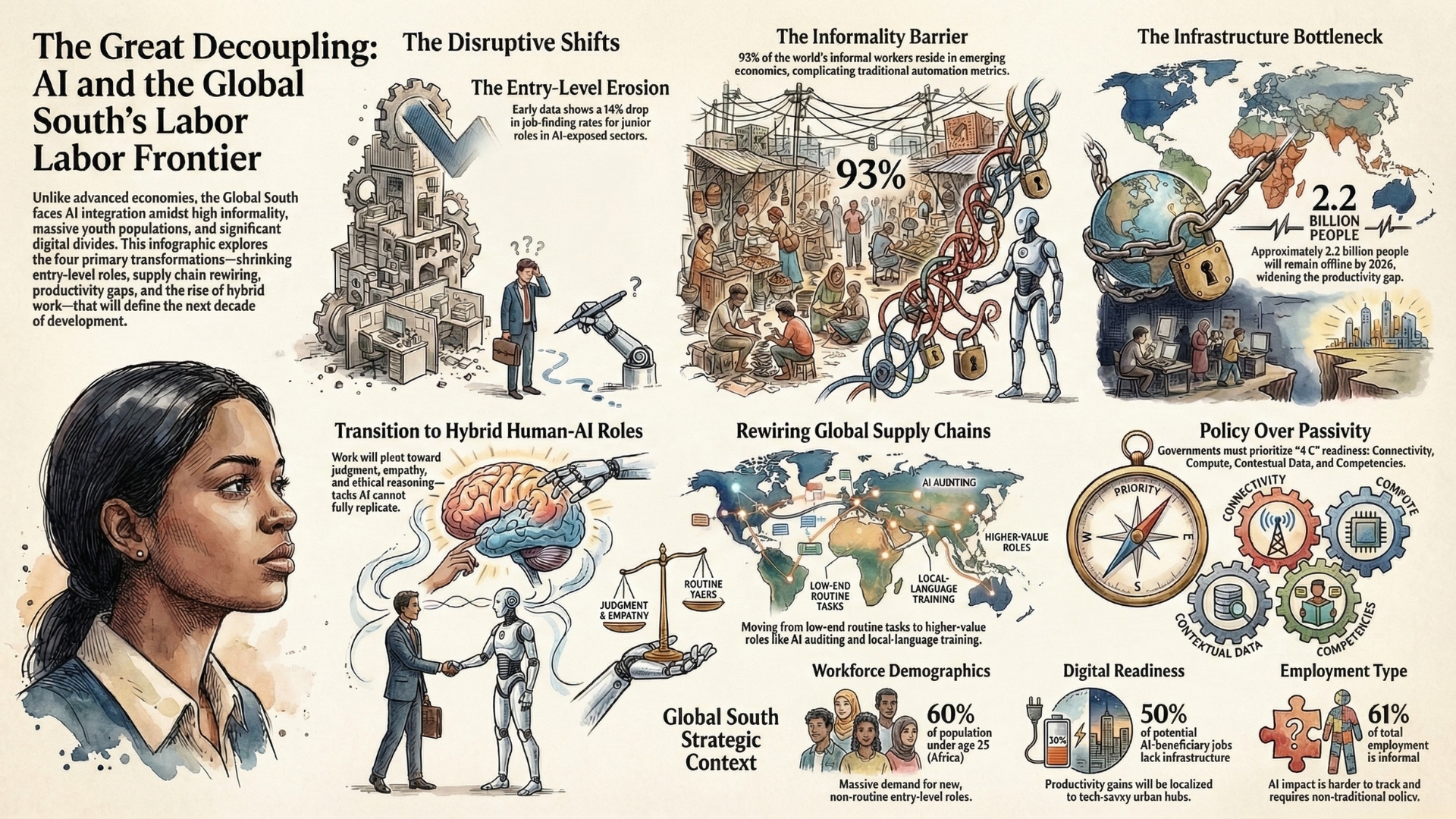
Artificial intelligence is reshaping labor markets globally, but its effects will look very different in developing economies. New studies suggest that generative AI could automate a large share of routine office and information tasks. However, today’s Global South labor markets are dominated by informal, small-scale work, driven by youthful population growth and uneven digital infrastructure. Over the next decade, AI is unlikely to trigger mass layoffs in these regions. Instead, expect four broad shifts in how work is organized:
- Entry-level knowledge jobs will shrink. Generative AI already handles drafting, summarizing, coding and basic customer support. Many junior professional roles – especially outsourced information-processing tasks – will be automated or accelerated by AI. In practice, this means companies will hire fewer entry-level workers for routine tasks. Job growth will slow in call centers, back offices and basic data services, even if total layoffs remain modest.
- Global service chains will rewire. The Global South has built large BPO and IT service sectors (e.g. India, the Philippines, Kenya, Vietnam). AI tools could let firms do these services with leaner teams. Some routine work may “reshore” to advanced economies or be absorbed by bots. At the same time, new niches will open – data labeling, local language AI-training, algorithm audit, and other human-in-the-loop tasks. The net effect will depend on how quickly workers in developing countries shift into these new AI-related roles.
- Productivity gaps will widen. AI is a general-purpose technology, but it depends on strong digital foundations. Recent World Bank analysis identifies “connectivity, compute, contextual data, and skills” as critical building blocks for AI readiness. In practice, this means firms (and regions) with fast internet, good computing power and data will pull ahead. A joint ILO–World Bank study in Latin America finds that up to half of the jobs that could benefit from AI are currently held back by poor infrastructure and limited access to technology. Without intervention, large cities and tech-savvy companies will see most AI gains, while rural areas and smaller firms fall further behind.
- Hybrid human–AI jobs will emerge. Rather than entirely replacing workers, AI will alter many occupations. For example, doctors may use AI to flag potential diagnoses, lawyers may use AI for legal research, and teachers may use AI tools to personalize lessons. In these scenarios, the human role shifts to oversight, interpretation, and interpersonal skills. Workers will need judgment, ethical reasoning, domain expertise and communication to “orchestrate” AI systems effectively. The most resilient job roles will be those that AI can assist but not fully displace.
This brief outlines how these trends might play out across developing economies. We identify policy priorities – from building digital infrastructure to revamping education – that can help the Global South harness AI’s benefits and avoid widening inequality. In short, the coming decade will not be a replay of historical automation shocks. Instead, it offers a window of opportunity to shape AI adoption: governments, firms and educators must act now if AI is to become a tool for inclusion rather than exclusion.
1. The Global South Workforce Today
To foresee AI’s impact, we first must understand the starting point. In much of Africa, Asia and Latin America, employment looks very different than in advanced economies. Roughly two-thirds of workers in developing countries are in the informal economy – that is, in small businesses, self-employment or casual work without formal contracts or social protections. For example, agriculture and street vending are often informal, and small “microenterprises” dominate many job markets. By contrast, high-income countries have much larger formal sectors.
Three features stand out in today’s Global South labor markets:
- High informality. A large share of workers lack formal contracts or social security. The ILO reports that about 61% of the world’s employed people work informally, and 93% of those informal workers are in emerging and developing countries. Informality means jobs are often precarious, low-paid and not easily measured in official statistics, making workforce shifts harder to track.
- Youth bulges. Many developing countries have fast-growing young populations. Africa exemplifies this: over 60% of Africans are under age 25 today, and by 2035 more young Africans will enter the job market each year than the rest of the world combined. South Asia and parts of Latin America also see large youth cohorts. This youth “surplus” creates huge demand for entry-level jobs but also leaves governments racing to create enough new positions.
- Digital connectivity gaps. Mobile phones have spread rapidly, but reliable high-speed internet and compute power remain uneven. Tens or hundreds of millions are still offline, and many who are online face slow or expensive service. For example, one estimate suggests around 2.2 billion people will still lack internet access in 2026. Even where 4G networks exist, broadband bandwidth and data-center capacity can be very limited. These constraints affect who can use AI tools at all.
These underlying conditions—informality, demographics, and digital divides—will mediate every effect of AI on the workforce. They explain why initial AI adoption has been slower in low-income settings. In short, many developing economies start with more manual, small-scale work and less digital automation to displace. This doesn’t mean AI won’t matter – but it shapes how and where it matters.
2. The First Transformation: The Decline of Entry-Level Knowledge Work
Generative AI systems excel at routine cognitive tasks: drafting emails and reports, summarizing documents, translating text, conducting background research, basic coding support, and handling scripted customer inquiries. These are exactly the core tasks of many junior professional and outsourcing roles. An entry-level analyst or data-entry clerk often spends their days on just these activities.
As AI tools improve, employers will increasingly automate or accelerate such tasks. Early evidence from advanced economies already hints at this shift. For instance, U.S. data show a 14% drop in the job-finding rate for young workers in highly exposed occupations after ChatGPT’s release (versus older workers). In practice, companies can get the same work done with fewer interns or new graduates.
For the Global South, the impact is likely to be even sharper. Many developing countries built their service industries around low-cost labor. India’s IT and business-process outsourcing (BPO) industry, for example, employs millions in entry-level coding and call-center roles. If AI takes over the most routine portions of these jobs, firms will slow new hiring. The change may not come as sudden layoffs—global demand for services can still grow—but the growth trajectory of these sectors will flatten. New offshore contracts may assume an AI assistant on Day 1 rather than a team of fresh graduates.
Concrete examples help illustrate this shift. A tech company might once have hired a dozen junior software testers to manually validate code. Today, that testing can be partly automated by AI tools, so the company might hire only a few testers and use AI scripts for the rest. Similarly, a multinational might have staffed its Manila call center with hundreds of trainees reading FAQ scripts. AI-powered chatbots can now handle the simplest queries, reducing the number of entry-level agents needed.
Several industry reports note that even as some mid-level and senior tech roles continue to grow, the pipeline of fresh jobs for new grads may thin. In India, for example, the IT sector reported a 16% year-on-year increase in hiring in early 2025 – but this was driven largely by demand for AI, cloud and specialized skills. Purely routine roles were notably absent from that surge.
Hard truth: In economies where millions counted on graduate schemes and outsourcing contracts as pathways out of poverty, those paths will narrow. Students and trainees may find that basic internships and traineeships are scarcer. This means education-to-job entry must adapt: young people will need to come to the workplace with different skills or be directed toward new opportunities (discussed below) if they are not to end up unemployed or underemployed.
3. The Second Transformation: Reorganization of Global Service Supply Chains
For the past two decades, countries like India, the Philippines, Kenya and Vietnam have thrived by integrating into global service supply chains. They became hubs for outsourcing digital services: from call centers and back-office processing to data moderation and multilingual translation. These jobs were often attractive stepping stones to higher incomes and formal training in globalized industries.
AI threatens to rewrite these supply chains in two ways:
-
Automation within outsourcing firms. AI can amplify productivity inside existing BPO/IT companies. A typical service firm might use AI assistants to handle routine portions of projects, leaving a smaller team of human workers for oversight and complex tasks. This means that a given contract no longer requires, say, 20 people in an offshore center – maybe just 8. Margins rise, but job growth slows. As PwC and others note, AI-driven workflow automation is boosting BPO profitability today, but at the risk of fewer hires.
-
Reshoring of tasks. Some tasks might migrate back to rich countries. If AI in a U.S. law firm can draft basic legal memos automatically, the firm might need fewer paralegals in India. Already, analysts note a trend toward “AI-enabled reshoring” of certain services. In short, labor-cost arbitrage is eroded if advanced economies can outsource a smaller share of work to LLMs instead of people.
At the same time, new opportunities will open in AI-driven supply chains. AI systems need human inputs: they must be trained on local language data, evaluated for quality, and kept up-to-date. This creates demand for jobs such as data annotators, model trainers, and AI content moderators. Crucially, these roles often must be done by people in diverse languages and contexts. A social media company might rely on Nepali or Swahili speakers in Nairobi or Bengaluru to review AI-generated content for cultural accuracy. These emerging roles will grow in importance.
However, many of these nascent jobs share a familiar pattern: they tend to be low-paid, contractual and precarious. A recent study highlights that data-labeling and verification work in the Global South is often done through online platforms or low-regulation BPO shops. Workers may face unpredictable hours and piece-rate pay. Strategic lens: Policymakers should notice that this pattern replicates old exploitative rhythms of outsourcing. If AI jobs in the Global South just become another form of precarious gig work, broad economic inclusion will suffer. Instead, there is an opportunity to formalize and upgrade these roles – for example, by training data workers in higher-level AI oversight, or by encouraging firms to co-develop AI products locally (see policy section below).
In summary, the second transformation will shift where and how work is done, not necessarily eliminate all jobs. The Global South’s role in service value chains will change from low-end grunt work to higher-value or supervisory roles – but only if that transition is managed. The risk is falling into a new “low-wage trap” where local workers do the dirty work (content flagging, voice transcription, etc.) while core AI innovations remain abroad. The high leverage point here is to move up the value chain: nations must foster local AI expertise so that the next generation of AI tools are designed with Global South languages and markets in mind, rather than being imposed from outside.
4. The Third Transformation: Rising Productivity Inequality
AI is a general-purpose technology – it can improve productivity in manufacturing, services, agriculture, you name it. But experience shows that new technologies usually amplify existing disparities unless carefully managed. In the AI era, who has access to AI matters immensely.
Firms and regions with strong digital foundations will see their productivity (output per worker) jump, while others lag. Consider two small factories of equal size: one uses AI-driven quality control and inventory management (made possible by good internet and cloud data), and the other still relies on pen-and-paper. The first factory will become much more competitive. Likewise, a city with reliable broadband can support an AI-powered call center and attract new investment; a rural area with spotty Wi-Fi will struggle even to deploy basic automation.
This digital divide is sometimes called the AI “haves” and “have-nots.” The World Bank’s recent AI report emphasizes the “4 Cs” needed for AI readiness – Connectivity, Compute, Contextual data, and Competencies (skills) – and finds that low-income countries often fall short on one or more pillars. Empirical evidence from Latin America underscores this gap: roughly 17 million jobs there could be made more productive by AI, but half of those positions are in places with insufficient digital access.
The consequence will be rising inequality between firms and regions. Large firms with capital to invest in AI and data collection will pull ahead. Small and medium enterprises (SMEs), which dominate many Global South economies, often lack the scale to digitize. Urban areas will benefit first, widening the rural–urban divide. Within countries, we may see a new version of the “Matthew effect”: the tech-savvy get richer, and the rest fall further behind.
Consider Argentina versus Paraguay: a bank in Buenos Aires might roll out an AI-powered loan-approval system next year, boosting its productivity. A Paraguayan bank with poorer internet and fewer trained data specialists may only start digitizing basic record-keeping. Over time, these gaps compound, affecting national GDP growth and job creation patterns.
Without targeted intervention, AI could worsen economic inequality. For example, a UN analysis notes that digital employment opportunities are heavily concentrated in advanced regions, intensifying income disparity. To avoid this, governments in the Global South will need to invest preemptively. Broadband expansion, cloud infrastructure, and data-sharing platforms are not luxuries but foundations for an inclusive AI-driven economy. At the same time, data must be generated locally. AI systems need local language and market data, which requires digitizing processes (e.g. agriculture records, medical imaging, local languages) that have long been analog.
Strategic challenge: It is not enough to passively wait for global AI products to trickle down. Instead, a conscious strategy is needed: to upgrade infrastructure and data ecosystems so that when new AI tools emerge, they can actually be used in schools, clinics and factories across the Global South. Otherwise, the next productivity boom will largely bypass large portions of the population.
5. The Fourth Transformation: Emergence of Hybrid Human–AI Work
Even as AI automates routine tasks, it will also create entirely new ways of working. Many occupations will evolve into hybrid roles where humans and AI work together. The key shift is that humans will focus on what machines can’t: judgment, creativity, social interaction and domain expertise.
Consider these illustrative examples:
- Healthcare: AI systems can help interpret medical images or suggest diagnoses, but a doctor must validate the results, consider patient context and manage treatment. An AI tool might flag a suspicious nodule on an X-ray, but the radiologist’s expertise and empathy are still needed to determine the next step.
- Legal services: AI legal research can sift through millions of cases in seconds. A paralegal with AI tools can therefore work much faster, focusing on crafting strategy and client communication.
- Agriculture: Farmers may use AI-driven apps to diagnose crop diseases from leaf photos, but they still apply local knowledge about weather, soil and community practices to decide remedies.
- Education and training: AI can personalize tutoring or grading, but teachers still provide motivation, tailor lessons to students’ interests, and impart cultural values.
In these hybrid settings, the balance of tasks changes. Workers spend less time on rote chores and more on oversight, exception-handling, and collaboration. As a result, the most valuable skills become those that are hard to automate:
- Problem framing and design. Workers need to translate real-world problems into clear inputs for AI. For instance, a project manager must define what success looks like before feeding data into an AI model.
- Critical evaluation. AI outputs can be wrong or biased. Skilled workers will need to recognize when to trust AI advice and when to reject it. This requires domain knowledge and healthy skepticism.
- Social and emotional intelligence. Jobs requiring negotiation, empathy, teaching and leadership will remain human-led. For example, even in a high-tech customer service center, issues involving upset clients or nuanced complaints require human touch.
- Adaptability and learning. The rapid pace of AI change means workers must constantly update their skills and learn new tools. Lifelong learning becomes essential.
This is an encouraging flip-side: jobs will not simply vanish, but evolve. The labor complementarity – humans plus machines – can boost productivity and even create new occupations (e.g. “AI system trainer” or “digital wellness coach”). However, this demands a very different workforce than what many education systems currently produce.
6. Skills for the AI Economy
Traditional schooling in many developing countries emphasizes memorization and passing exams. In an AI-augmented workplace, these are the least useful skills. Instead, curricula and training programs must pivot toward the capabilities listed above. In practice, this means:
- Focus on critical and creative thinking. Classroom exercises should ask students to define problems, generate multiple solutions, and critique arguments. For example, instead of rote math drills, give students real data and ask them to spot patterns or question anomalies – the kind of reasoning an AI cannot fully replicate.
- Emphasize digital and data literacy. Nearly every job will require some comfort with computers, data interpretation and basic coding or digital tools. Schools and vocational programs should ensure broad access to computers and encourage students to tinker with technology. (UNESCO reports highlight that communities without regular computer access fall further behind.)
- Teach social and communication skills. Group projects, debates and writing assignments build collaboration, negotiation and empathy. These “soft skills” are surprisingly hard to automate yet crucial for hybrid work. For instance, a cooperative robotics task in class can teach both tech basics and teamwork.
- Integrate ethical and cultural training. As AI tools enter work and society, understanding ethical use and societal impacts becomes important. Curricula should include discussions about AI bias, data privacy, and the role of technology in society.
Education reform is a long-term challenge, but some countries are already experimenting. India’s new curricula emphasize critical thinking and project-based learning. Rwanda and Morocco are integrating ICT training into secondary schools. These efforts need to scale. Public-private partnerships can help: tech companies often run “coding bootcamps” and coding-for-children initiatives (as seen in Nigeria and Brazil) that could be models to expand.
In the meantime, adult reskilling programs will be critical. Mid-career workers in formal sectors should be given incentives or mandates to learn AI tools relevant to their jobs. Experience from around the world shows that well-designed training – especially when employers are involved – can ease transitions. For example, job-placement schemes that require basic data analysis or AI-awareness modules could be piloted in partnership with local industry.
Without these shifts, a mismatch will emerge: employers will demand problem-solving, communication and digital savvy, while a generation of workers will still have only conventional diplomas. Closing that gap is one of the most pressing policy tasks of the AI era.
7. Policy Priorities for the Next Decade
The changes above will not happen automatically or evenly. Governments in the Global South need proactive strategies to tilt the outcome toward inclusive growth. The following policy priorities stand out:
- Invest in digital infrastructure. Reliable broadband, affordable mobile data, and local cloud/data centers are prerequisites for AI adoption. Countries should treat high-speed internet and compute capacity as public utilities. Examples include Kenya’s national fiber backbone build-out and India’s semiconductor/AI chip investments. Energy supply also matters: factories and offices need stable electricity to run servers and devices. Prioritizing rural connectivity (e.g. subsidies for ISPs in low-profit areas) can avoid a situation where only major cities benefit. As one World Bank analysis notes, expanding infrastructure in rural areas will be “crucial for enabling AI adoption where it can be most beneficial”.
- Support workforce transitions. Rather than only teaching people to code AI algorithms (which only a few can), focus on complementary skills that amplify human-AI teamwork. This includes critical thinking, communication, and adaptability as noted above. Active labor programs can identify sectors at risk (like call centers or back offices) and provide retraining vouchers or short courses to those workers. For example, a garment export zone could partner with a tech company to train factory office staff as “quality audit managers” who use AI tools to inspect products. Crucially, vocational training should involve industry mentors so that curriculums match actual demand.
- Encourage AI augmentation over replacement. Through grants or tax incentives, governments can nudge firms to use AI in ways that complement workers. One idea is an “AI apprenticeship” subsidy: companies receive support when deploying AI tools that raise worker productivity and keep headcount stable. Another is to fund public-sector AI pilots focused on augmenting human jobs – for instance, an AI-based diagnostic system in public hospitals that speeds doctors’ work, rather than replacing nurses with AI monitors. Some nations are experimenting with “future of work” task forces to guide such strategies. The hard truth is that without deliberate policies, profit motives alone will favor automation; public policy must balance this by rewarding human-centered innovation.
- Strengthen labor statistics and research. Policymakers cannot manage what they don’t measure. The informality and hybrid nature of many jobs means traditional statistics will miss key trends. Countries should invest in better labor-force surveys that capture gig work, underemployment and AI use. This may involve new questions on AI tools at work, or using mobile surveys to reach informal workers. Regional labor observatories (like in some ASEAN states) could also track how service industries are evolving in real time. Better data will allow more agile policy (e.g. if we see a sudden shift away from certain occupations, targeted support can be deployed).
- Build domestic AI ecosystems. To avoid dependence on foreign AI tools, governments can foster local innovation. This can be through R&D grants, startup incubators, or public-sector use cases that involve local talent. For example, a government health department might sponsor the development of an AI medical app tailored to regional diseases and languages. International partnerships also help: several Global South countries are partnering with the World Bank or UNESCO on national AI strategies (assessing readiness and building roadmaps). The key is to ensure that AI applications are grounded in local needs, not just imported ideas. Over time, a strong local AI industry can both create high-skilled jobs and keep more value within the country.
These priorities carry trade-offs. For instance, subsidizing infrastructure requires upfront spending and public-private coordination. Reskilling programs may face low initial uptake as workers cling to familiar skills. Nevertheless, the leverage is high: targeted interventions today can determine whether millions get left behind or find new opportunities. The “hard truth” for policymakers is that inaction is not neutral – it cements existing inequities. As one analysis bluntly puts it, the choices made now will decide if “AI becomes a tool for inclusive development or exacerbates existing inequalities”.
8. Strategic Implications for the Global South
The stakes over the next decade are immense. Developing economies face two stark futures:
-
Passive path (current trajectory): AI tools will be developed and optimized largely in high-income countries and tech hubs. Multinationals will integrate the cheapest automation into their global operations, trimming some outsourced jobs. Weaker regions will struggle to catch up, as richer countries race ahead in productivity. Informal and low-skilled workers may find jobs increasingly scarce or stagnant, exacerbating unemployment and poverty. Existing gaps in education and infrastructure widen, making late industrializers fall even further behind the frontier.
-
Proactive path (influenced outcomes): Governments, businesses and civil society in the Global South actively shape AI adoption. They invest in infrastructure, adapt education and labor laws, and guide private deployment toward inclusive goals. New homegrown AI applications emerge for local needs (e.g. drones for agriculture, Swahili speech-recognition in call centers). As a result, AI-driven gains are spread across the economy: small firms boost their productivity, regional economies develop their tech clusters, and workers transition into higher-value roles instead of being left behind.
Which path unfolds is not predetermined. The analytical assumption underlying our brief is that agency matters. The Global South is not doomed to passively absorb the costs of tech developed elsewhere. But it will require deliberate effort. This means data-driven policy, international collaboration (for standards and investment), and political will to invest in people as well as machines.
A strategic lens also highlights that context matters. For example, a policy effective in a middle-income country might fail in a fragile state. Countries should diagnose their own bottlenecks. Does a rural region need better grid power to even plug in a computer? Does an education ministry have the flexibility to overhaul exams? Tailored solutions will vary – one size does not fit all. That said, sharing lessons (for instance, successful digital skills programs in Kenya or affordable broadband models in India) can accelerate progress across the Global South.
9. Conclusion
Artificial intelligence will transform labor markets worldwide, but its impact will not be uniform. In the Global South, the most visible changes over the next decade will likely be slower job creation in service industries, emergence of hybrid human–AI roles, and growing productivity gaps between digital “haves” and “have-nots.” Entry-level white-collar jobs will shrink relative to the past, but new tasks and industries will arise if workers and firms adapt.
The critical question is not whether AI will arrive (it will), but how it arrives. Will AI adoption reinforce existing inequalities or become a catalyst for broader inclusion? The “hard truth” is that there is no technological fix without policy fix. Governments must shape the conditions of AI adoption now: by building infrastructure, reforming education, and incentivizing human-centered innovation. If they succeed, AI could accelerate development – improving public services, creating higher-skilled jobs, and boosting incomes. If they fail, the opposite will happen: inequality will widen, and large segments of the population will find their career ladders shortened.
The coming years are a choice point. As one World Bank analysis warns, many developing countries have a “unique window of opportunity” to influence AI’s role in the workforce. The question for readers and decision-makers alike is clear: will we rise to that opportunity and build an AI-empowered workforce, or passively await the consequences? The time to decide is now.
10. References
- International Labour Organization (2018), Women and Men in the Informal Economy: A Statistical Picture (3rd ed.) – ILO Newsroom (data on 61% informal, 2 billion people).
- World Bank (2025), Blogs – Protect and Invest in People: “AI’s impact on jobs may be smaller in developing countries” (Demombynes et al.) – global AI exposure analysis and policy advice.
- Partnership for Economic Policy (2024), “The Opportunities and Challenges of AI for Labor Markets in the Global South” (Iván Pineda et al.) – discusses new AI-related work (data annotation, digital labor) and labor conditions.
- International Labour Organization & World Bank (2024), Buffer or Bottleneck? Employment Exposure to Generative AI and the Digital Divide in Latin America (Working Paper 121) – key findings on jobs exposed to AI and infrastructure gaps.
- World Economic Forum (2023), “How Africa’s youth will drive global growth” (Mpemba & Munyati) – youth demographics, by 2035 African workforce growth比rest of world.
- DevelopmentAid (2026), “Bridging the digital divide: Why connectivity alone is not enough” (Hes) – estimates 2.2 billion still offline by 2026; notes uneven digital infrastructure in developing regions.
- India Brand Equity Foundation (IBEF, 2025), “IT & BPM Industry Report Nov 2025” – data on India’s IT sector growth, hiring increase (16% YoY driven by AI/cloud).
- PwC (2023), “Global Services Industry Study” – notes that AI-driven automation is boosting outsourcing firm margins while reducing labor needs.
Related in this cluster
- The Global South AI Labor Index: A Framework for Monitoring AI’s Workforce Impact
- What Anthropic’s AI Jobs Study Misses in the Global South
- Browse all AI Workforce posts
📥 AI in Workforce Series: AI and the Global South Workforce: The Next 10 Years (PDF)
👉 Download the Case Study Deck (PDF)
Stay tuned — new posts every week!
💬 Join the Conversation
Have thoughts, experiences, or questions about AI fairness? Share your comments, discuss with global experts, and connect with the community:
👉 Reach out via the Contact page
📧 Write to us: [email protected]
🌍 Follow GlobalSouth.AI
Stay connected and join the conversation on AI governance, fairness, safety, and sustainability.
- LinkedIn: https://linkedin.com/company/globalsouthai
- Substack Newsletter: https://newsletter.globalsouth.ai/
Subscribe to stay updated on new case studies, frameworks, and Global South perspectives on responsible AI.
Related Posts

AI’s Green Promises: A Deceptive Mirage of Sustainability
Why efficiency-focused 'Green AI' claims often hide deeper environmental, social, and governance costs—especially in the Global South.
The Global South AI Labor Index: A Framework for Monitoring AI’s Workforce Impact
Artificial intelligence is beginning to reshape labor markets worldwide, yet most current studies measure its impact using indicators designed for advanced economies. In the Global South, workforce disruption is more likely to appear through rising informality, wage compression, underemployment, and shrinking entry-level opportunities rather than immediate job losses. This policy brief introduces the Global South AI Labor Index and an accompanying AI Labor Risk Dashboard to help governments detect early signals of AI-driven workforce transformation. Together, these tools provide a practical monitoring framework for managing the labor impacts of AI in developing economies.

The Silent AI Shock in Workforce: An India Case Study
Why unemployment statistics will miss the real disruption of AI in the workforce in the Global South