The Global South AI Labor Index: A Framework for Monitoring AI’s Workforce Impact
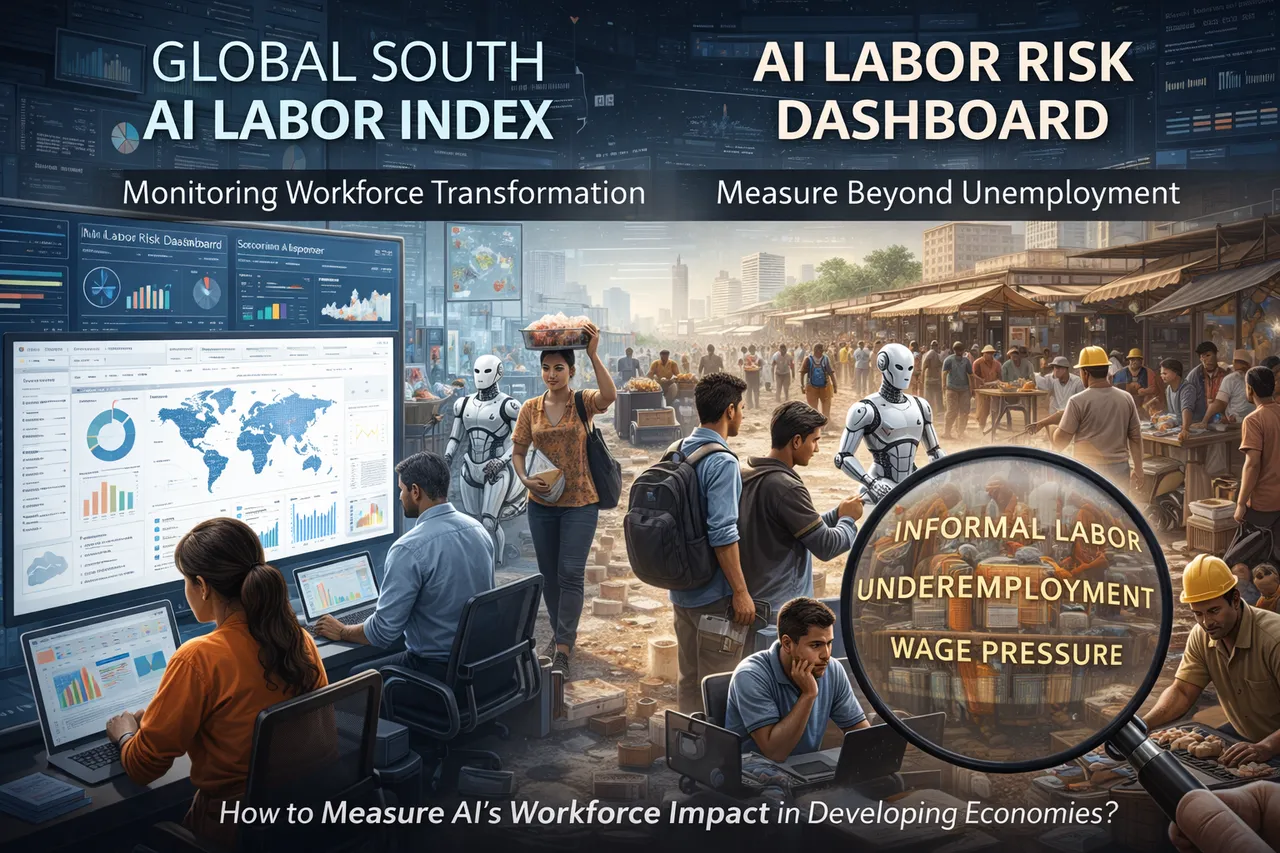
Artificial intelligence is beginning to reshape labor markets worldwide, yet most current studies measure its impact using indicators designed for advanced economies. In the Global South, workforce disruption is more likely to appear through rising informality, wage compression, underemployment, and shrinking entry-level opportunities rather than immediate job losses. This policy brief introduces the Global South AI Labor Index and an accompanying AI Labor Risk Dashboard to help governments detect early signals of AI-driven workforce transformation. Together, these tools provide a practical monitoring framework for managing the labor impacts of AI in developing economies.
AI in Workforce
Part 2 of 4
Table of Contents
- Global South AI–Labor Index & Risk Dashboard
- AI in Workforce - Explainer
- 1. What Problem This Framework Is Trying to Solve
- 2. Why Standard AI Jobs Studies Can Miss the Global South
- 3. What the First Warning Signs May Look Like
- 4. What the Global South AI-Labor Index Tracks
- 5. How the Dashboard Would Work in Practice
- 6. What Policymakers Should Do With It
- 7. Bigger Picture
- Related in this cluster
- 📥 AI in Workforce Series: The Global South AI Labor Index and Risk Dashboard - A Framework for Monitoring AI’s Workforce Impact (PDF)
- 💬 Join the Conversation
- 🌍 Follow GlobalSouth.AI
- Subscribe to stay updated on new case studies, frameworks, and Global South perspectives on responsible AI.
Global South AI–Labor Index & Risk Dashboard
AI in Workforce - Explainer
- 🧭 Core idea: many Global South countries need better ways to detect AI-driven labor stress before it shows up in unemployment data
- ⚠️ Main concern: AI disruption may appear first through wage pressure, informality, underemployment, and blocked youth entry into jobs
- 🛠️ Proposed solution: a Global South AI-Labor Index paired with a dashboard to track early warning signals
- 🌍 Why it matters: a framework built for formal labor markets can miss how workforce change actually unfolds in developing economies
⚠️ Key Takeaway
In the Global South, AI may reshape work long before it causes visible mass unemployment. If governments only watch headline job-loss numbers, they may miss the first signs of economic stress.
1. What Problem This Framework Is Trying to Solve
Most public debate about AI and jobs focuses on one question: how many jobs will disappear?
That is a useful question in advanced economies with large formal labor markets and strong statistical systems. But it is not enough for many developing economies, where work is often informal, unstable, or split across several income sources.
In those settings, AI disruption may show up first in quieter ways:
- workers keep their jobs but earn less
- entry-level hiring slows down
- more people shift into informal or gig work
- underemployment rises before unemployment does
That is the gap this post is trying to address. It proposes a Global South AI-Labor Index and an AI-Labor Risk Dashboard as early-warning tools for labor ministries, researchers, and policymakers.
2. Why Standard AI Jobs Studies Can Miss the Global South
Recent AI labor studies, including work centered on the United States, often look at occupational exposure and unemployment trends[1][2]. That approach can be useful in more formal economies.
But Global South labor markets are shaped by conditions that make disruption harder to see in official unemployment figures:
- High informality: many workers move between self-employment, casual work, family labor, and platform work.
- Working poverty: people may remain employed but still face falling income or worsening conditions[3].
- Youth pressure: large numbers of young people are already struggling to enter stable work[5][6].
- Digital inequality: AI adoption depends on connectivity, compute, skills, and language access[7][8].
This means a country can experience real AI-driven labor stress even if unemployment data looks stable.
3. What the First Warning Signs May Look Like
If AI starts reshaping labor markets in developing economies, the earliest signals are likely to include:
- Earnings pressure: wages flatten or fall even if employment levels do not collapse.
- Informalization: workers pushed out of formal roles move into unstable or lower-protection work.
- Youth bottlenecks: graduates and first-time workers struggle to find entry-level openings.
- Underemployment: people remain technically employed but get fewer hours or lower-value tasks.
- Sector stress: outsourcing, customer support, digital services, and other exposed sectors begin to weaken.
A call-center hub, for example, may not report a dramatic wave of layoffs at first. Instead, it may see fewer new hires, slower wage growth, more contract work, and shrinking hours. That is exactly the kind of pattern a better monitoring framework should capture.
4. What the Global South AI-Labor Index Tracks
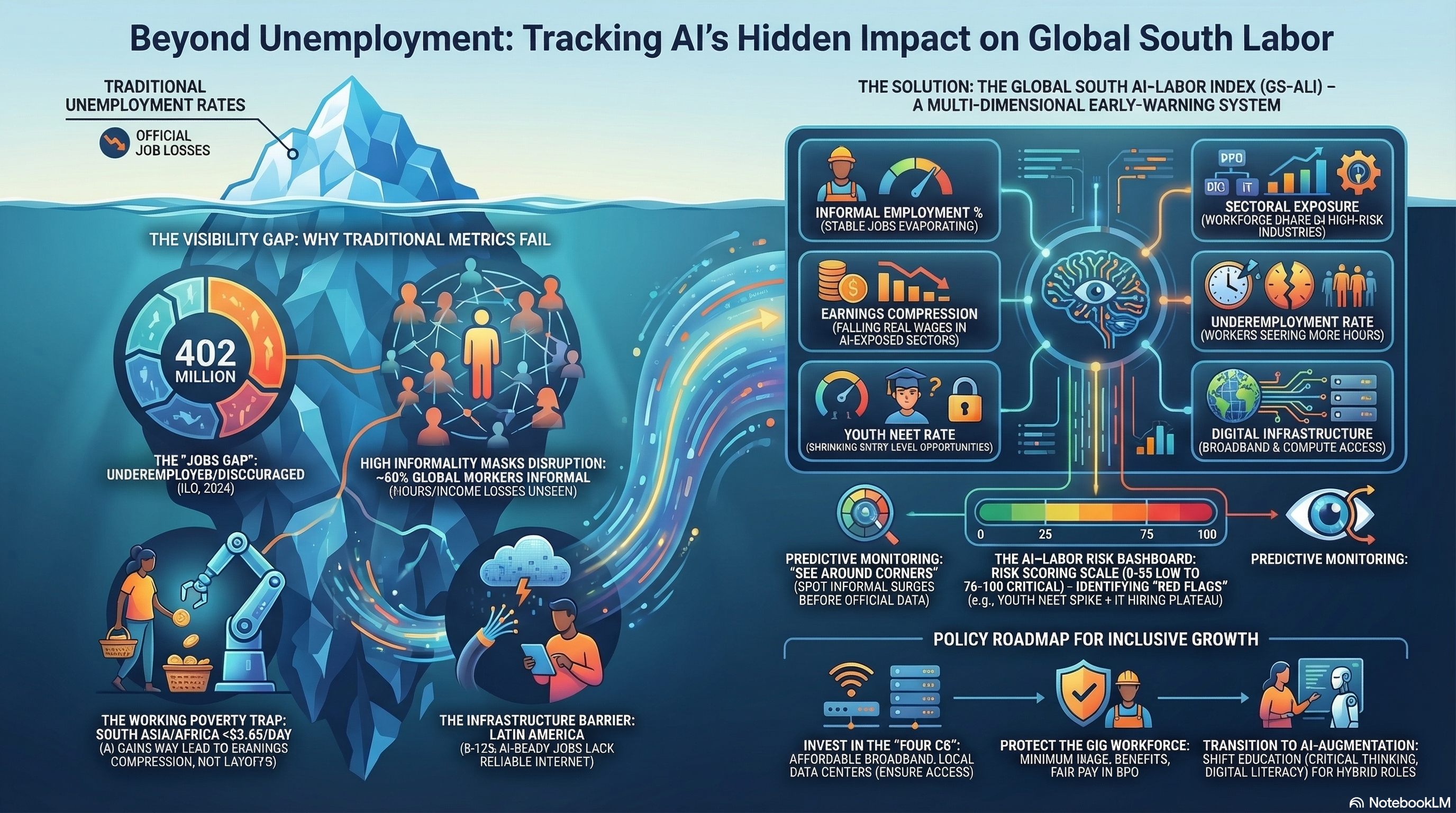
The proposed index is built around six core pillars:
| Pillar | What it asks |
|---|---|
| Informality and job quality | Are workers moving into more precarious or less protected work? |
| Earnings pressure | Are wages, hours, or pay conditions worsening in AI-exposed sectors? |
| Youth pathways | Are young people finding it harder to enter stable jobs? |
| Sectoral exposure and adoption | Which industries are most exposed, and how fast are firms adopting AI? |
| Underemployment stress | Are people technically employed but getting less work or lower-value work? |
| Digital and governance readiness | Do institutions have the infrastructure and oversight needed to respond? |
This makes the framework broader than a simple automation score. It looks at both labor outcomes and the conditions that shape how AI spreads through an economy.
Why these six pillars matter
- Informality matters because labor stress often appears there first.
- Earnings matter because falling income can signal disruption before job loss does.
- Youth pathways matter because AI can narrow entry routes into professional work.
- Sector exposure matters because labor shocks are rarely evenly distributed.
- Underemployment matters because reduced hours and weaker task quality are real forms of distress.
- Digital readiness matters because countries cannot manage AI well if they lack basic infrastructure and institutional capacity.
5. How the Dashboard Would Work in Practice
The index becomes more useful when paired with a dashboard.
The dashboard would track changes over time and help policymakers answer questions such as:
- Is informality rising in an AI-exposed service sector?
- Are young workers facing weaker hiring conditions in BPO or IT services?
- Are wages falling while firm-level AI adoption is increasing?
- Are some regions under more stress than others?
Instead of presenting isolated statistics, the dashboard would combine them into a clearer labor-risk picture.
One practical option is to score conditions on a 0 to 100 risk scale:
- 0-25: low labor stress
- 26-50: moderate stress
- 51-75: high risk of disruption
- 76-100: critical conditions needing urgent response
That would not replace deeper analysis. But it would give governments a faster way to detect worsening conditions before they become full labor-market crises.
6. What Policymakers Should Do With It
The point of the index is not just to observe change. It is to support action.
If a country adopts a framework like this, several policy uses become possible:
- Improve labor statistics so they capture informality, underemployment, platform work, and AI adoption patterns.
- Create an AI-Labor Observatory to publish regular updates and identify sector-level risks early.
- Invest in digital readiness including connectivity, local-language tools, data systems, and workforce skills.
- Protect vulnerable workers by strengthening labor standards for gig, contract, and other precarious forms of work.
- Support AI-augmented transitions through training, retraining, and better pathways into new forms of work.
- Coordinate internationally so labor ministries and research institutions can compare signals across countries.
The broader idea is simple: if AI is going to change work, governments need instruments that help them see those changes early and respond before the damage deepens.
7. Bigger Picture
The debate over AI and jobs is often framed around dramatic headlines about mass unemployment. But in the Global South, the more likely short-term story is slower and less visible:
- more unstable work
- weaker earnings
- blocked entry for young workers
- growing pressure in already fragile labor markets
That is why better measurement matters.
The Global South AI-Labor Index and dashboard are useful not because they predict the future perfectly, but because they push policymakers to watch the right signals. If governments can detect stress early, they stand a better chance of shaping AI adoption toward inclusive growth rather than hidden labor erosion.
Table: Proposed Global South AI–Labor Index Metrics (illustrative)[4][6]
| Indicator | Data Source / Rationale |
|---|---|
| Informal employment share (%) | ILO SDG data[4] – % of workforce informal. |
| Earnings pressure (real wages) | National surveys (ILO/World Bank) – trends in wages in exposed jobs. |
| Youth NEET rate (%) | ILO/UNESCO – % of 15–24 not in education/employment[6]. |
| Sectoral exposure (BPO, IT) | Labor force surveys – % in high-exposure industries (from O*NET). |
| Underemployment rate (%) | ILO – % of employed wanting more hours (ICLS definition). |
| Digital access (connectivity) | ITU/World Bank – % with internet/smartphone[8]. |
References
[1] Anthropic Economic Index: https://www.anthropic.com/economic-index
[2] Anthropic, Labor Market Impacts of AI: https://www.anthropic.com/research/labor-market-impacts
[3] ILO, World Employment and Social Outlook: Trends 2024: https://www.ilo.org/publications/world-employment-and-social-outlook-trends-2024
[4] World Economic Forum, Global informal economy explained: https://www.weforum.org/agenda/2024/01/global-informal-economy-explained/
[5] ILO India country/statistical resources (youth labour indicators): https://www.ilo.org/country/india
[6] ILOSTAT data portal (incl. youth NEET indicators): https://www.ilo.org/ilostat
[7] ILO publications (including Global South/Latin America AI labour studies): https://www.ilo.org/publications
[8] World Bank Digital Development (including the “four Cs” framing): https://blogs.worldbank.org/digital-development
[9] Rest of World reporting on AI and BPO/call-center workflows: https://restofworld.org/
Related in this cluster
📥 AI in Workforce Series: The Global South AI Labor Index and Risk Dashboard - A Framework for Monitoring AI’s Workforce Impact (PDF)
👉 Download the Case Study Deck (PDF)
Stay tuned — new posts every week!
💬 Join the Conversation
Have thoughts, experiences, or questions about AI and the future of work? Share your comments, discuss with global experts, and connect with the community:
👉 Reach out via the Contact page
📧 Write to us: [email protected]
🌍 Follow GlobalSouth.AI
Stay connected and join the conversation on AI governance, fairness, safety, and sustainability.
- LinkedIn: https://linkedin.com/company/globalsouthai
- Substack Newsletter: https://newsletter.globalsouth.ai/
Subscribe to stay updated on new case studies, frameworks, and Global South perspectives on responsible AI.
Related Posts
AI and the Global South Workforce: The Next 10 Years
A Strategic Outlook for Labor, Development, and Artificial Intelligence

The Silent AI Shock in Workforce: An India Case Study
Why unemployment statistics will miss the real disruption of AI in the workforce in the Global South

What Anthropic’s AI Jobs Study Misses in the Global South
Anthropic’s recent study on AI and jobs offers valuable insights into how artificial intelligence may affect labor markets in advanced economies. But the same framework does not fully capture how workforce disruption unfolds in the Global South—where informality, youth employment pressures, and service outsourcing shape labor market realities.