Kenya's Digital ID Crossroads: How Huduma Namba and Maisha Namba Risk Exclusion by Design
How Kenya's shift from Huduma Namba to Maisha Namba exposes the fairness, legal, and infrastructure failures that can turn digital identity into exclusion by design.
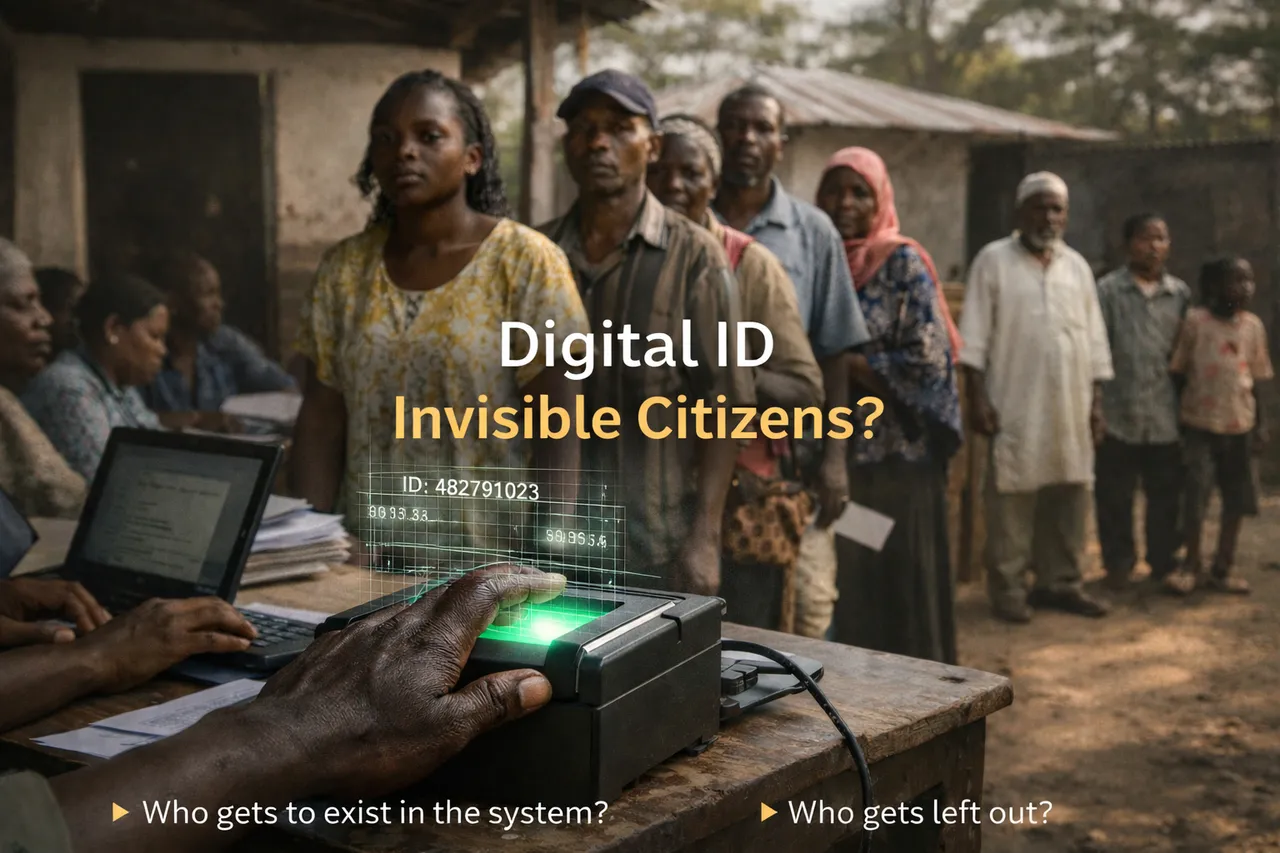
AI Fairness 101 - Real-World Incidents
Part 11 of 13
Table of Contents
- 🎥 Explained: Kenya’s Digital ID Crossroads: How Huduma Namba and Maisha Namba Risk Exclusion by Design
- 🧵 AI Fairness 101 — Real-World Incident #11: Kenya’s Digital ID Crossroads
- 🔍 Kenya’s Digital ID Crossroads: From Huduma Namba to Maisha Namba
- 1. What Happened: From Huduma Namba to Maisha Namba
- 2. The Human Impact: When Identity Systems Exclude
- 3. Lifecycle Failure: Putting the Cart Before the Horse
- 4. Bias Types: Historical, Representation, and Accessibility Bias
- 5. The Global South Lens: Infrastructure, Colonial Legacies, and Imported Assumptions
- 6. The Bigger Picture: Trust Is the Real Infrastructure
- References
- Related in this cluster
🎥 Explained: Kenya’s Digital ID Crossroads: How Huduma Namba and Maisha Namba Risk Exclusion by Design
🧵 AI Fairness 101 — Real-World Incident #11: Kenya’s Digital ID Crossroads
A case study in how digital identity can become exclusionary when legal safeguards, infrastructure realities, and historical inequities are treated as afterthoughts.
🔍 Kenya’s Digital ID Crossroads: From Huduma Namba to Maisha Namba
- 🛠️ System used: Kenya's national digital identity infrastructure, first through Huduma Namba and now through Maisha Namba
- 👥 Most affected group: people already facing documentation hurdles, including minority communities, undocumented residents, rural households, and single-parent families
- ⚠️ Core failure: the state kept pushing a centralized digital ID project before fully resolving legality, safeguards, and real-world access constraints
- 📉 Outcome: digital identity risked becoming a gatekeeper for citizenship, mobility, and public services rather than a tool for inclusion
⚠️ Key Takeaway
A digital ID system is not fair just because it is centralized, modern, or biometric. If the system inherits historic exclusion and is rolled out before safeguards exist, it can turn legal identity into a privilege instead of a right.
Kenya’s digital identity story is often framed as a modernization project. In practice, it has become a revealing case study in how states can use the language of efficiency, integration, and digital transformation while reproducing older patterns of exclusion. The shift from Huduma Namba to Maisha Namba did not erase the underlying governance problems. It mostly repackaged them.
This matters because digital identity is rarely just an administrative database. Once linked to public services, banking, movement, or citizenship verification, it becomes a gatekeeping infrastructure. In that setting, design flaws do not stay technical. They become social, legal, and material harms.
1. What Happened: From Huduma Namba to Maisha Namba
Kenya’s digital ID journey has unfolded through a cycle of ambitious launch, legal challenge, rebrand, and renewed rollout.
- In 2019, the government launched the National Integrated Identity Management System (NIIMS), commonly known as Huduma Namba.
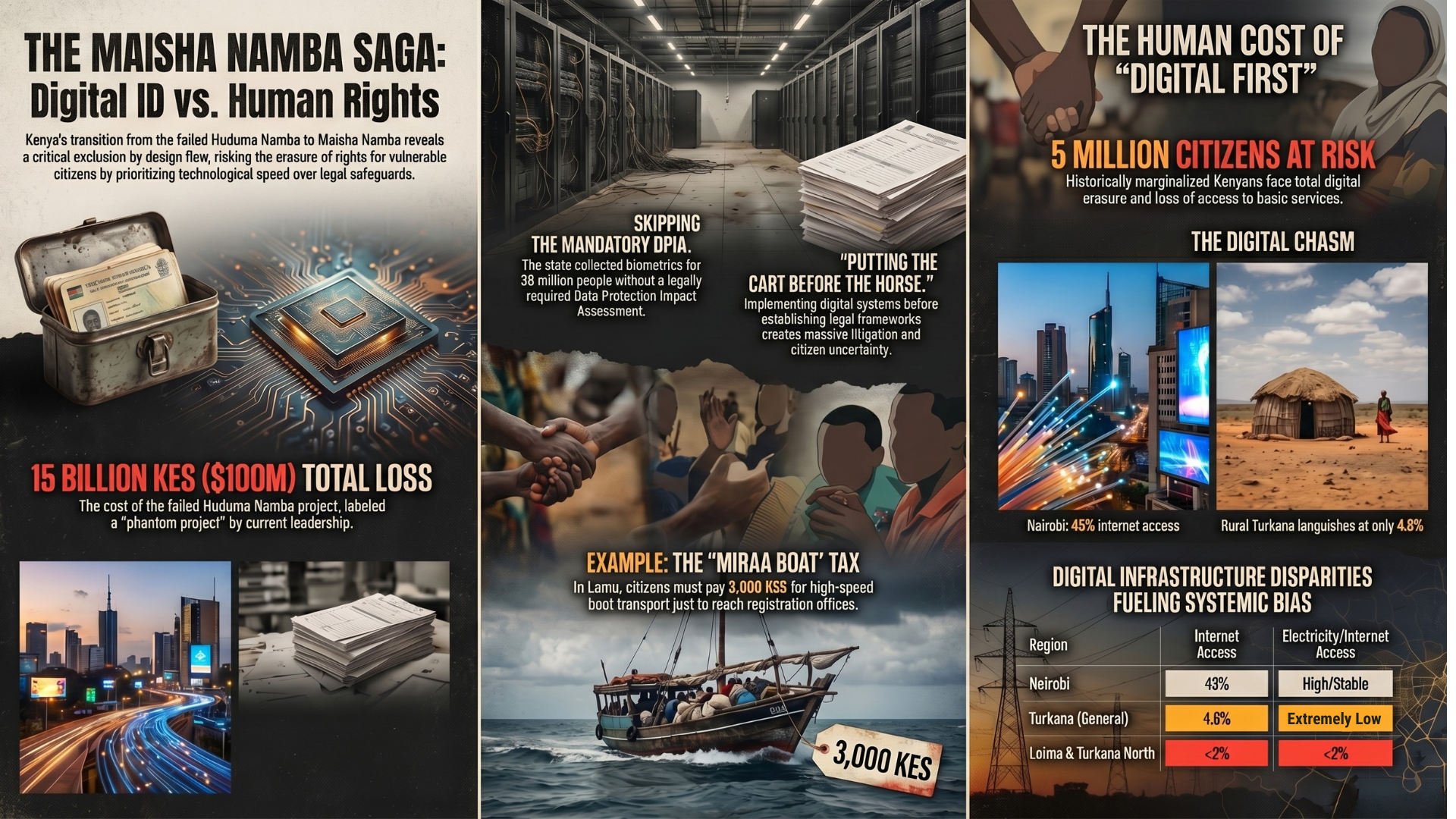
- In 2021, the High Court ruled against aspects of the rollout, emphasizing that the state had failed to complete a required Data Protection Impact Assessment (DPIA) before proceeding.
- President William Ruto later described Huduma Namba as a “fraud” or “phantom project”, arguing it had consumed major public resources without delivering the promised value.
- In 2023, the state moved toward Maisha Namba, built around a Unique Personal Identifier (UPI), a Maisha Card with a chip, and a centralized Master Register.
- In February 2024, legal barriers were partially lifted, allowing the government to resume implementation momentum.
The transition is often described as a clean reset. It is better understood as a continuity problem. The state changed branding and architecture language, but many of the core fairness concerns remained intact: unclear legal anchoring, insufficient participation, unresolved documentation inequities, and the risk that digital identity would be made effectively mandatory before the state could guarantee equal access.
Judge Jairus Ngaah captured the deeper governance problem in a line that has become central to this debate:
“I will stand with the individual against the might of the state … [the implementers] put the cart before the horse.”
That phrase matters because it describes more than a procedural lapse. It describes a design philosophy: deploy first, justify later.
2. The Human Impact: When Identity Systems Exclude
The clearest test of a digital identity system is not whether it is technically elegant. It is whether ordinary people can secure recognition without humiliation, delay, or arbitrary exclusion.
In Kenya, the harms are concentrated among the people least able to absorb administrative friction.
- Roughly 5 million people already facing barriers to documentation and citizenship risk being pushed further to the edge of formal recognition.
- During the transition period, around 600,000 applicants were reportedly left in limbo when legacy ID issuance slowed while the new model was still contested.
- Single parents can face rigid registration requirements that do not reflect their real family circumstances.
- Communities such as the Nubian, Makonde, and Pemba have long faced extra vetting burdens, and digital centralization risks hardcoding those burdens into the next system.
- In some local settings, applicants reported demands for unofficial payments just to move documentation processes forward.
This is what makes the case so important from a fairness perspective. The exclusion is not only digital. It is bureaucratic, geographic, historical, and economic. A person can be left out because their paperwork is incomplete, because a local office is far away, because informal fees are demanded, or because the state has already classified their community as suspicious.
Once a digital ID becomes a prerequisite for access to everyday life, these frictions stop being administrative inconveniences. They become barriers to rights.
3. Lifecycle Failure: Putting the Cart Before the Horse
Kenya’s digital ID problems are best understood as lifecycle failures rather than isolated implementation bugs. The system repeatedly moved ahead before the fairness foundations were in place.
| Lifecycle phase | What went wrong | Fairness consequence |
|---|---|---|
| Public participation | Consultation was treated as narrow or procedural rather than meaningfully deliberative | Citizens experience the system as imposed on them, weakening trust and surfacing harms too late |
| Legal design | Rollout moved faster than durable parliamentary and constitutional grounding | The system remained vulnerable to repeated litigation and uncertainty |
| Pre-deployment review | Sensitive biometric and identity data were pursued before a robust DPIA was completed | High-risk harms, especially exclusion and function creep, were not properly mitigated in advance |
| Data integration | The new system depended on existing records already shaped by unequal access to registration | Historical exclusion risked being imported into the centralized register |
| Service delivery | Physical access, electricity, internet, and travel costs were not treated as core system constraints | People in remote or marginalized settings bore the highest burden of compliance |
The skipped or weakened DPIA is especially important. A DPIA is not a paperwork exercise. In a system of this scale, it is one of the few formal opportunities to identify foreseeable harms before they are normalized. If exclusion risks for communities like the Nubians were already well known, then failure to incorporate those risks into design is not neutral. It is a fairness failure.
4. Bias Types: Historical, Representation, and Accessibility Bias
Digital identity systems often look neutral because they are wrapped in administrative language. But their biases usually come from what they inherit, what they assume, and what they ignore.
Representation Bias
If the underlying records are incomplete or historically discriminatory, the digital system will reproduce that unevenness. A family that was previously under-documented or over-vetted does not become visible simply because the state creates a new database. It may instead become newly legible only as an exception, anomaly, or problem case.
For communities such as the Nubian or Makonde, this is not a hypothetical concern. If recognition has historically been delayed or conditional, a centralized master register can lock that disadvantage in place.
Accessibility Bias
A digital-first model assumes that people can reliably reach registration points, navigate procedures, and interact with supporting infrastructure. That assumption breaks down quickly in places where electricity, internet access, transport, or document availability are fragile.
The contrasts are stark:
- Nairobi reportedly has far higher connectivity than many rural counties.
- In Turkana, connectivity levels remain much lower.
- In some constituencies such as Loima, Turkana East, and Turkana North, access to electricity or the internet is extremely limited.
If digital identity depends on a digital environment that large parts of the country do not actually have, then the system is biased toward the already connected.
Vetting Bias
Some groups are not merely under-served. They are actively subjected to heavier scrutiny. Minority and Muslim communities have long reported prolonged vetting, misplaced documents, and repeated administrative hurdles. When these patterns are incorporated into a digital identity workflow, the system can transform discretionary suspicion into standardized procedure.
Function Creep
A centralized identity system also creates the risk that data gathered for recognition will later be used for surveillance, profiling, or cross-system control. That risk becomes more serious when public trust is already weak and legal limits are unsettled.
5. The Global South Lens: Infrastructure, Colonial Legacies, and Imported Assumptions
Kenya’s case cannot be understood only as a technical modernization story. It sits inside a wider Global South pattern in which digital identity is promoted as development infrastructure while deeper questions of rights, history, and state capacity receive less attention.
The history matters. Kenya’s modern identity regime exists in the shadow of the Kipande, the colonial identity pass used to monitor and control African labor. That does not make every current digital ID initiative illegitimate. But it does mean identity systems are never just neutral administrative tools in post-colonial contexts. They carry memory, asymmetry, and political weight.
The infrastructure reality matters too. A state may imagine a sleek chip-enabled identity card and an integrated national register. But that vision can collide with a citizen’s actual life:
- long travel distances to an office,
- high transport costs,
- inconsistent electricity,
- weak internet,
- and a lack of foundational documents such as birth certificates.
In that environment, the burden of modernization falls downward. The state becomes digitally efficient by making already-marginalized people absorb the friction.
International development actors also shape this landscape. Global institutions often promote the idea that digital ID naturally leads to legal identity, inclusion, or service delivery. Kenya’s case suggests that this chain of logic is far too neat. A sophisticated identity layer does not fix exclusion if the surrounding social and legal system is still unequal.
6. The Bigger Picture: Trust Is the Real Infrastructure
The deepest lesson from the Huduma Namba and Maisha Namba saga is that trust is the real infrastructure of digital government.
Without trust, even technically advanced systems are interpreted as coercive. Without due process, efficiency feels like dispossession. Without genuine inclusion, digital identity becomes a sorting machine.
A rights-respecting path forward would require Kenya to:
- Treat legal grounding and parliamentary scrutiny as prerequisites, not obstacles.
- Make DPIAs and rights-impact assessments central to rollout decisions.
- Preserve non-digital and offline access paths so that identity is never contingent on perfect infrastructure.
- Prioritize issuance of birth certificates and foundational documents for underserved communities before layering on more digital requirements.
- Standardize and constrain vetting practices so that minority groups are not trapped in permanent suspicion.
- Ensure fast, local, affordable appeals and redress mechanisms when records are wrong or applications stall.
The strategic question is simple but profound: is digital identity being designed to recognize people, or to discipline them?
Kenya’s digital ID transition is therefore not just a story about one country’s database architecture. It is a warning about what happens when governments build identity systems around administrative ambition without equally strong commitments to fairness, legality, and lived access.
References
- Amnesty International Kenya, Ready or Not? Citizens’ Perspectives on Maisha Namba.
- KICTANet, Diving into Kenya’s Digital Future.
- Kenya Human Rights Commission, Government Shouldn’t Force Flawed Digital ID System.
- Voices at Temple, Laura Bingham, The Cart Before the Horse.
- JURIST, Edwin Gakunga, Kenya’s New National Digital ID System.
- Amnesty International Kenya, county fact sheets on connectivity and service access.
📥 AI Fairness 101 — Real-World Incidents
Related in this cluster
- When an Algorithm Broke Thousands of Families: The Netherlands Child Welfare Scandal
- Access Denied: How India’s Digital ‘Cure-All’ Became a Real-World Fairness Crisis
- The Golden Touch of Ruin: How Michigan’s MiDAS Algorithm Falsely Accused 40,000 People of Fraud
- The COMPAS Algorithm Scandal: When AI Decides Who Goes to Jail
- Browse all AI Fairness posts
🔎 Explore the AI Fairness 101 Series
This post is part of the AI Fairness 101 - Real-World Incidents learning track.
Stay tuned - new posts every week.
💬 Join the Conversation
Have thoughts, experiences, or questions about AI fairness? Share your comments, discuss with global experts, and connect with the community:
👉 Reach out via the Contact page
📧 Write to us: [email protected]
🌍 Follow GlobalSouth.AI
Stay connected and join the conversation on AI governance, fairness, safety, and sustainability.
- LinkedIn: https://linkedin.com/company/globalsouthai
- Substack Newsletter: https://newsletter.globalsouth.ai/
Subscribe to stay updated on new case studies, frameworks, and Global South perspectives on responsible AI.
Related Posts
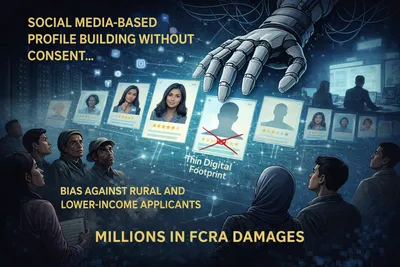
AI Hiring Gone Wrong: How Eightfold’s Social Media Profiling Sparked a Fairness and Consent Crisis
A 2026 lawsuit against Eightfold AI reveals how job applicants may have been secretly scored using social media and online data, without consent or transparency. The case exposes how AI hiring systems can replicate bias, exclude candidates with thin digital footprints, and create massive legal and fairness risks. What happens when invisible algorithms decide who gets a chance?
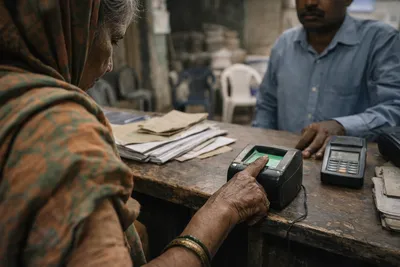
Access Denied: How India's Digital 'Cure-All' Became a Real-World Fairness Crisis
How Aadhaar’s promise of digital inclusion turned into one of the largest algorithmic exclusion crises in the world.

The COMPAS Algorithm Scandal: When AI Decides Who Goes to Jail ⚖️
As AI enters courts and welfare systems worldwide, the COMPAS debate reveals a critical lesson: fairness depends on context, and exporting models without reform risks scaling inequality.