
When an Algorithm Broke Thousands of Families: The Netherlands Child Welfare Scandal
How a design-phase failure in the Dutch childcare fraud algorithm created one of the worst AI governance disasters in Europe — and what the Global South must learn from it.

AI Fairness 101 - Real-World Incidents
Part 1 of 4
Table of Contents
- 🧵 AI Fairness 101 — Real-World Incident #1: The Netherlands Child Welfare Algorithm Scandal
- 🎥 Explained: The Netherlands Child Welfare Algorithm and Systemic Harm
- 🔍 Designed to Suspect: How a Dutch Welfare Algorithm Broke Thousands of Families
- 🧠 1. What Happened: A Flawed Hunt for Fraud
- 👨👩👧👦 2. The Human Impact: A National Catastrophe
- 🧭 3. Lifecycle Failure: Where It All Went Wrong
- 🎭 4. The Bias Unmasked: Institutional and Algorithmic Discrimination
- 🌍 5. The Global South Lens: A Warning for the Future
- 📌 6. The Bigger Picture: Lessons for a Digital Age
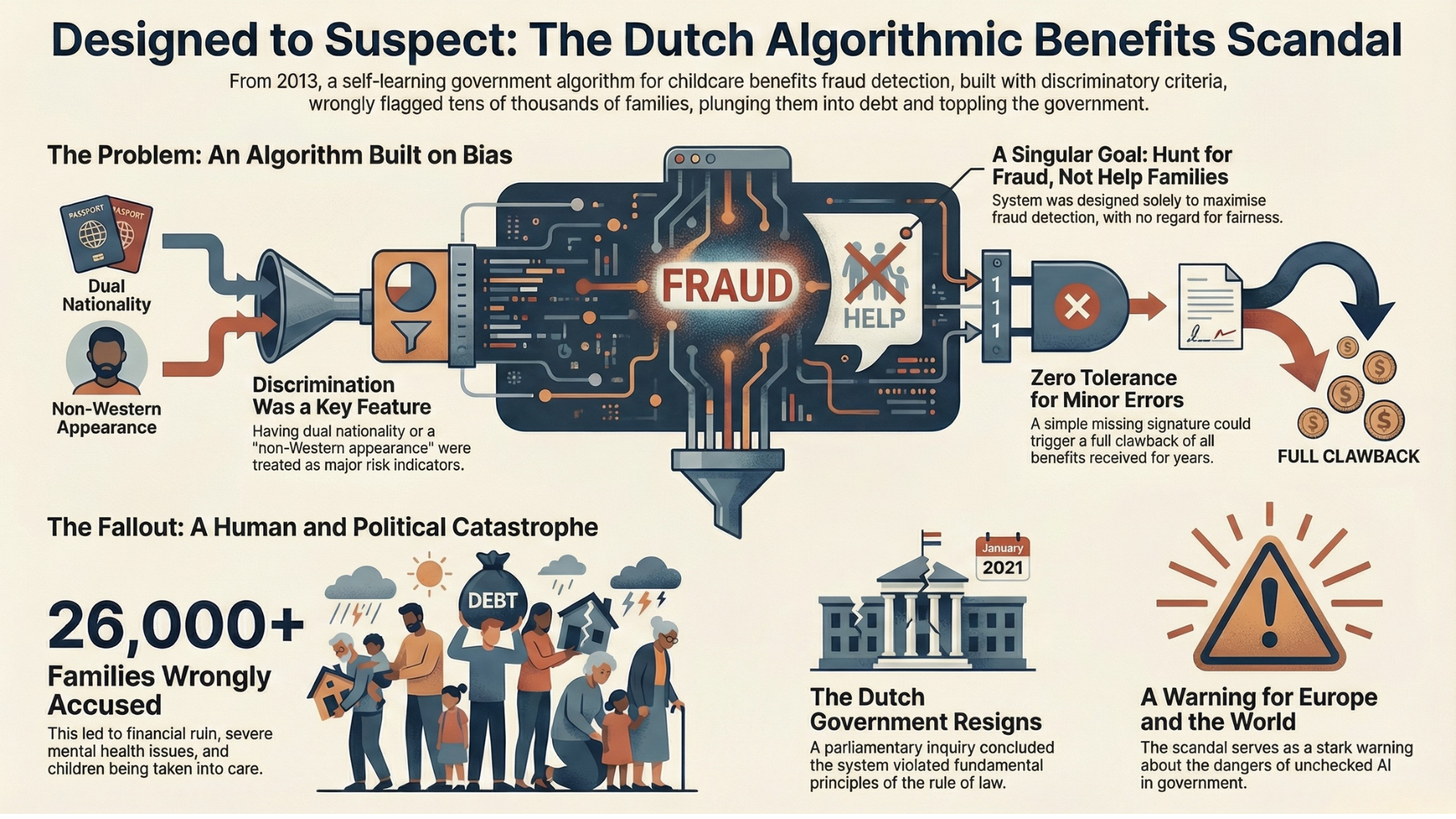
- <img src="/assets/images/AIFairness101_Real-Incidents_2020_Design_Gov-Welfare_Netherland-child-welfare_Infographic_v1.png" alt="Dutch child welfare algorithm scandal" style="width:100%; border-radius:10px; margin: 1rem 0;" />
- 📚 References
- 📥 AI Fairness 101 — Real-World Incidents: Netherlands Child Welfare Scandal Case Deck (PDF)
- 🔎 Explore the AI Fairness 101 Series
- 💬 Join the Conversation
- 🌍 Follow GlobalSouth.AI
- Subscribe to stay updated on new case studies, frameworks, and Global South perspectives on responsible AI.
🧵 AI Fairness 101 — Real-World Incident #1: The Netherlands Child Welfare Algorithm Scandal
A powerful example of how fairness can fail before an algorithm is ever deployed — during the design phase.
🎥 Explained: The Netherlands Child Welfare Algorithm and Systemic Harm
🔍 Designed to Suspect: How a Dutch Welfare Algorithm Broke Thousands of Families
In the global race to build smarter, more efficient governments, the Netherlands became an unwitting pioneer of a different kind: a real-world, catastrophic case study in algorithmic harm. The Dutch childcare benefits scandal, known locally as the “toeslagenaffaire”, is a sobering account of how an automated system, born from a political obsession with rooting out fraud, ended up systematically dismantling the lives of tens of thousands of innocent families.
This post will deconstruct what happened, why the system failed so catastrophically, and the urgent lessons it offers to governments and organisations worldwide deploying AI systems. This is the story of the algorithm that broke thousands of families.
🧠 1. What Happened: A Flawed Hunt for Fraud
The scandal did not arise in isolation. It was born out of a political climate fixated on preventing abuse of the welfare system, which was intensified by a high-profile case known as “Bulgarian migrant fraud.” This created immense pressure on the Dutch Tax and Customs Administration to clamp down on perceived wrongdoing, leading them to embrace automation as the ultimate tool for “efficient fraud detection”. The system they built, however, would become an instrument of unprecedented injustice.
The scandal unfolded over more than a decade, with a flawed algorithm supercharging an already broken system:
- The System’s Goal: Beginning in 2013, they deployed a self-learning algorithm to create “risk profiles” of childcare benefit applicants. The explicit aim was to detect and deter fraud at an early stage.
- The Scale: Between 2005 and 2019, approximately 26,000 parents were wrongly accused of making fraudulent benefit claims and were ordered to repay their allowances in full, often amounting to tens of thousands of euros.
- The Trigger: The system penalised families based on a mere suspicion of fraud. In many cases, the trigger was a minor administrative error, such as a missing signature, which was then interpreted as a sign of deliberate wrongdoing.
- The Fallout: The discovery of the scandal’s full scope and the profound institutional failures that enabled it led to the resignation of the entire Dutch government, led by Prime Minister Mark Rutte, in January 2021.
These facts, however, only outline the mechanics of the failure. The true story lies in the devastating human cost inflicted upon thousands of citizens who were treated as guilty until proven innocent by an unyielding, opaque system.
👨👩👧👦 2. The Human Impact: A National Catastrophe
Behind the statistics and political resignations are shattered lives and a profound loss of trust in public institutions. The real-world consequences of this algorithmic failure serve as a powerful reminder that automated decisions have real, and sometimes irreversible, human impacts.
Chermaine Leysner was one of the thousands of victims. A social work student with three young children, her life was upended in 2012 by a letter demanding she repay over €100,000 in childcare benefits. The nine-year ordeal that followed drove her into depression and burnout and contributed to the separation from her children’s father. At her lowest point, she struggled to provide the basics. “I was working like crazy so I could still do something for my children, like give them some nice things to eat or buy candy. But I had times that my little boy had to go to school with a hole in his shoe,” she recalled. Her initial disbelief quickly turned into a nightmarish reality.
“I thought, ‘Don’t worry, this is a big mistake.’ But it wasn’t a mistake. It was the start of something big.” — Chermaine Leysner, Victim of the Scandal
Ms Leysner’s story was tragically common. The system’s “zero-tolerance” approach created a ripple effect of devastation that touched every aspect of the victims’ lives.
The Devastating Consequences
-
Financial Ruin: Tens of thousands of families were pushed into poverty, losing their homes and jobs due to insurmountable debts imposed by the tax authority.
-
Family Separation: The extreme financial and emotional strain caused families to break apart. In the most heartbreaking cases, more than a thousand children were taken into foster care.
-
Extreme Hardship: Victims experienced severe mental health issues, including depression and burnout. The immense pressure and hopelessness led some to commit suicide.
-
Erosion of Trust: The experience left a deep scar on citizens’ faith in their government. As Chermaine Leysner stated, “If you go through things like this, you also lose your trust in the government.”
These catastrophic outcomes were not accidental. They were the direct and predictable result of critical failures in the system’s design, its underlying data, and the complete absence of oversight—failures that occurred at every stage of the AI lifecycle.
🧭 3. Lifecycle Failure: Where It All Went Wrong
The Dutch scandal was not a case of a “runaway AI” acting on its own. It was the product of a series of deliberate human choices made during the system’s design, development, and deployment. The technology simply executed a flawed and dangerous mission with terrifying efficiency. To understand the root cause, we must dissect the specific failures across the AI lifecycle.
3.1. A Flawed Objective: Sole focus on Fraud-Hunting
The system’s core design objective was fundamentally misaligned with the principles of a fair welfare state. Its mandate was explicitly to maximise the detection and deterrence of fraud—to “catch as many suspected fraudsters as possible.”
Conspicuously absent was any balancing objective, such as minimising false accusations, avoiding discrimination, or protecting the rights of children and vulnerable families. The goal was punishment and deterrence, not ensuring that eligible families received the support they were entitled to.
3.2. Biased by Design: Choosing Discriminatory Risk Factors
The data and features used to build the algorithm’s risk model were inherently discriminatory. Instead of carefully excluding protected attributes and their proxies, the system’s designers actively leveraged them as key indicators of risk. Investigations revealed that the model was built to flag individuals based on characteristics that should have been protected, including:
- Having a dual nationality.
- A perceived “non-Western appearance”.
- Low income.
As Amnesty International concluded, the policy choice to treat nationality as a risk factor meant that discrimination was “baked into the system from the beginning.”
The machine learning model operationalised this bias by inferring that “non-Dutch” parents were a higher risk, a direct result of the human decisions about which variables to feed into the system.
3.3. Governance by Opacity: No Checks, No Balances
The algorithmic system operated within a governance vacuum.
According to Pieter Omtzigt, the independent member of parliament who played a pivotal role in uncovering the scandal, there was a “total lack of checks and balances,” with no meaningful human oversight to question or correct the algorithm’s outputs.
Citizens were placed on secret blacklists with no way of knowing why they were flagged or how to defend themselves. This opacity was compounded by a “zero-tolerance” policy, where even a tiny administrative error could trigger a demand for the full clawback of all benefits received over many years.
This rigid rule turned minor model errors and simple human mistakes into “catastrophic life events”.
These technical and governance failures did not just create a flawed system; they built a powerful engine for institutionalising and scaling discrimination.
🎭 4. The Bias Unmasked: Institutional and Algorithmic Discrimination
The core issue at the heart of the “toeslagenaffaire” can be summarised in three words: discrimination by design. The algorithm did not merely contain unintentional bias; it was constructed as an instrument to enact pre-existing institutional biases on a massive, automated scale.
Subsequent investigations by the Dutch Data Protection Authority (DPA), Amnesty International, and a parliamentary committee unmasked the specific forms of discrimination at play.
-
Ethnic and Racial Profiling An official audit revealed that the tax authorities disproportionately focused on people with “a non-Western appearance”, with individuals of Turkish or Moroccan nationality being a particular focus.
The DPA later fined the tax administration for this practice, calling its processing of data on dual nationality “unlawful, discriminatory and therefore improper”.
-
Institutional Bias The parliamentary report that led to the government’s resignation identified “grave shortcomings, including institutional biases” within the tax authority. This confirmed that the algorithm was not an anomaly but a reflection of a deeper, systemic culture.
The failure was not just passive bias but active concealment; the report found that authorities were “hiding information or misleading the parliament”, which the algorithm then scaled with devastating efficiency.
-
Socioeconomic Discrimination The system was designed to view poverty itself as a risk factor. By flagging low-income families for extra scrutiny, the algorithm disproportionately targeted the very citizens who were most dependent on benefits and least equipped to fight back against false accusations.
The scandal forces a deeply uncomfortable question:
If this can happen in a wealthy, well-regulated, and institutionally strong European nation, what does it mean for the rest of the world?
🌍 5. The Global South Lens: A Warning for the Future
While the “toeslagenaffaire” is a Dutch tragedy, its lessons are universal. For nations in the Global South that are rapidly adopting digital public infrastructure and AI-driven governance, the Netherlands’ failure serves as a critical “warning for the future.” The risks of algorithmic harm are not just replicated but are often multiplied in contexts with different institutional safeguards and social structures.
The potential for catastrophic failure is heightened in the Global South for several reasons identified by experts:
- Weaker data protection regimes and legal frameworks.
- More fragile courts and appeals processes, making it harder for citizens to seek redress.
- Higher dependency on welfare and subsidies, raising the stakes of an incorrect decision.
- Greater prevalence of informal work, which can lead to “suspicious” or incomplete data patterns that are easily misread by rigid algorithms.
- Pre-existing histories of caste, tribe, and religious profiling that can be easily “baked into” new automated systems.
For any government considering AI for welfare distribution, fraud detection, or credit scoring, the Dutch case is not a distant problem. It is a clear and present warning of the dangers of designing systems without robust safeguards for human rights.
📌 6. The Bigger Picture: Lessons for a Digital Age
The “toeslagenaffaire” must be treated as a landmark event that informs the future of digital governance. It provides urgent, non-negotiable lessons about regulation, oversight, and the fundamental purpose of technology in the public sector. From the wreckage of this scandal, three critical takeaways emerge.
-
Humanity Must Remain in the Loop: The scandal exposed the profound danger of automation without accountability. Meaningful human oversight, clear appeal channels, and accessible redress mechanisms are not optional features; they are essential safeguards.
As the Dutch Digital Minister later stressed, governmental decisions based on AI must “always be treated afterwards by a human person.”
-
Regulation Must Focus on Users, Not Just Technology: Critics argue that existing frameworks like the EU’s AI Act focus too heavily on the private sector providers of AI systems. The Dutch scandal proves that the public sector users of high-risk AI must also be held to strict standards.
Regulation must govern how technology is deployed by the state, ensuring that fundamental rights are assessed and protected before a system is ever launched.
-
Welfare Systems Must Serve, Not Punish: As a UN Special Rapporteur observed, digital welfare systems can flip the very purpose of the state, turning a supportive social safety net into a “punitive apparatus.” The primary objective of public sector AI must be to protect and support citizens.
Optimising solely for fraud reduction or administrative efficiency without safeguarding against false accusations is a recipe for disaster.
For every data scientist, policymaker, and public servant working on AI in government, the Dutch benefits scandal must serve as a foundational lesson. It is a stark reminder that behind every data point is a human being and that the ultimate measure of a system’s success is not its efficiency but its fairness, its accountability, and its unwavering commitment to upholding human rights.
📚 References
- Dutch childcare benefits scandal, Dutch childcare benefits scandal (Wikipedia, 2005–2019).
- Amnesty International, Xenophobic Machines: Discrimination through unregulated use of algorithms in the Dutch childcare benefits scandal, 25 Oct 2021.
- Netherlands Institute for Human Rights investigation into discriminatory algorithmic enforcement (EquinetEurope, 2022).
📥 AI Fairness 101 — Real-World Incidents: Netherlands Child Welfare Scandal Case Deck (PDF)
👉 Download the Netherlands Fairness Case Deck (PDF)
🔎 Explore the AI Fairness 101 Series
This post is part of the AI Fairness 101 — Real-World Incidents learning track.
Stay tuned — new posts every week!
💬 Join the Conversation
Have thoughts, experiences, or questions about AI fairness? Share your comments, discuss with global experts, and connect with the community:
👉 Reach out via the Contact page
📧 Write to us: [email protected]
🌍 Follow GlobalSouth.AI
Stay connected and join the conversation on AI governance, fairness, safety, and sustainability.
- LinkedIn: https://linkedin.com/company/globalsouthai
- Substack Newsletter: https://newsletter.globalsouth.ai/
Subscribe to stay updated on new case studies, frameworks, and Global South perspectives on responsible AI.
Related Posts

The Golden Touch of Ruin: How Michigan’s MiDAS Algorithm Falsely Accused 40,000 People of Fraud
A deep dive into Michigan’s MiDAS unemployment fraud algorithm — and how design-phase failures, automation bias, and the removal of human oversight turned efficiency into injustice.

Access Denied: How India's Digital 'Cure-All' Became a Real-World Fairness Crisis
How Aadhaar’s promise of digital inclusion turned into one of the largest algorithmic exclusion crises in the world.

The COMPAS Algorithm Scandal: When AI Decides Who Goes to Jail ⚖️
As AI enters courts and welfare systems worldwide, the COMPAS debate reveals a critical lesson: fairness depends on context, and exporting models without reform risks scaling inequality.