When Good Intentions Go Global: Why the EU AI Act Doesn’t Fit the Global South
Why the EU AI Act—designed for data-rich, institutionally mature European economies—breaks down when applied to the Global South.

AI-Policies
Part 2 of 3
Table of Contents
- 🎥 Explained: Beyond the Brussels Effect – Why the EU AI Act Fails the Global South
- AI Policy Tracker - Explainer
- 1. What the EU AI Act Is
- 2. Why the Fit Is Difficult in the Global South
- 3. Why This Matters in Practice
- 4. The Sovereignty Problem
- 5. What a Better Approach Looks Like
- 6. Bigger Picture
- Related in this cluster
- 📥 AI Policy Tracker — EU AI Act and the Global South Explainer Deck (PDF)
- 💬 Join the Conversation
- 🌍 Follow GlobalSouth.AI
- Subscribe to stay updated on new case studies, frameworks, and Global South perspectives on responsible AI.
🎥 Explained: Beyond the Brussels Effect – Why the EU AI Act Fails the Global South
AI Policy Tracker - Explainer
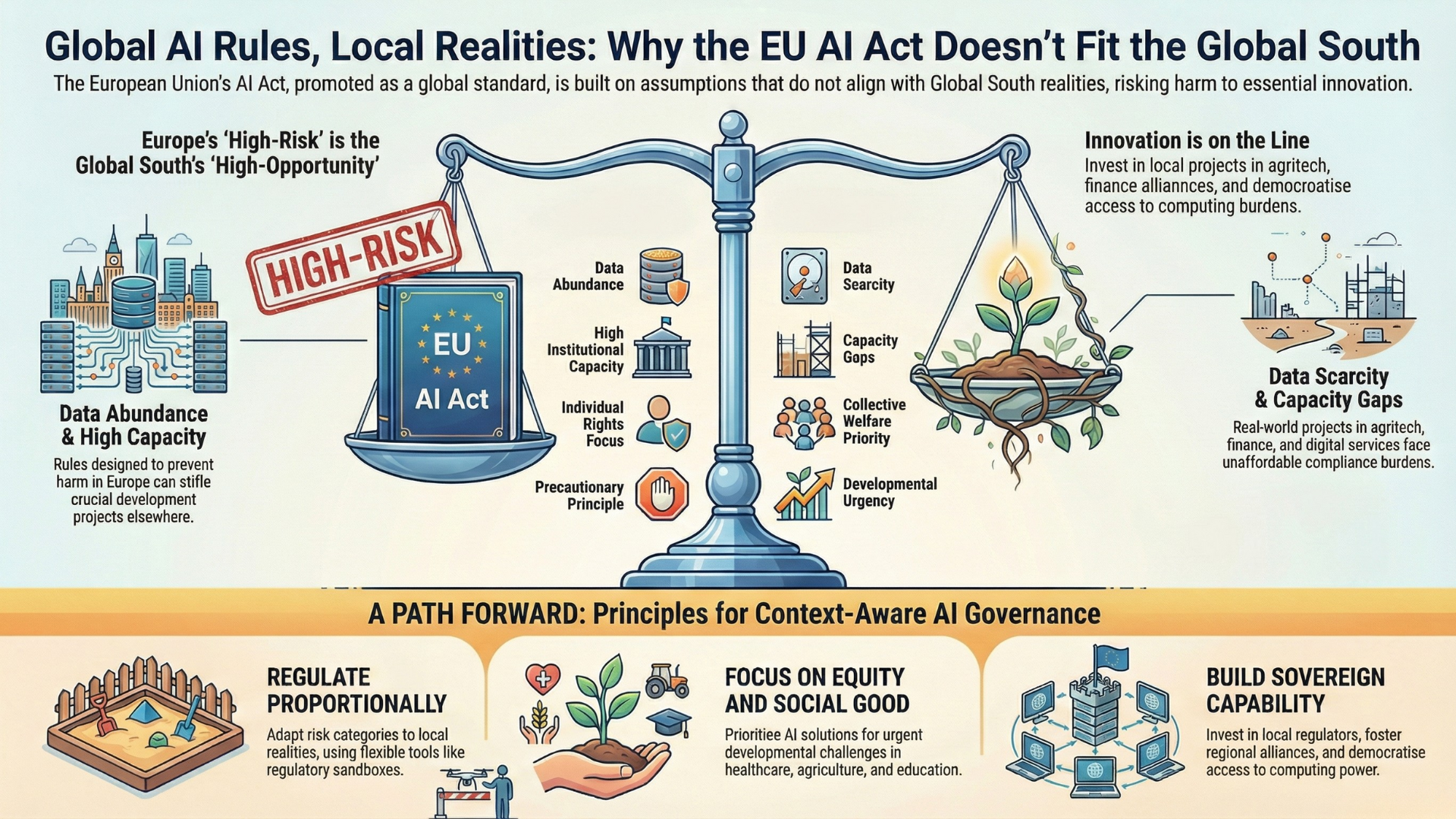
- 🇪🇺 Framework: the EU AI Act is a risk-based AI regulation designed for European legal and institutional conditions
- ⚠️ Main concern: rules built for data-rich, high-capacity environments may not transfer cleanly to low-capacity and unequal contexts
- 🌍 Global South implication: imported compliance standards can raise costs, slow useful deployment, and still miss local risks
- 🧭 Core lesson: the question is not whether to regulate AI, but how to adapt regulation to local realities
⚠️ Key Takeaway
The EU AI Act is important, but it is not a universal template. If copied without adaptation, it can create compliance burdens that do not match Global South realities.
1. What the EU AI Act Is
The European Union’s AI Act is often described as the world’s most influential AI law. Its basic idea is simple: regulate AI systems according to risk. Systems seen as more dangerous face stricter obligations, while lower-risk systems face lighter rules.
That approach makes sense in a region with strong institutions, established regulators, extensive documentation practices, and relatively high organizational capacity.
The problem is that these assumptions do not always hold in the Global South.
2. Why the Fit Is Difficult in the Global South
The biggest issue is not that the EU AI Act is badly designed for Europe. It is that it was designed for Europe.
Four structural mismatches matter most:
- Data conditions are different. Many countries lack clean, complete, well-labeled datasets, especially outside elite urban sectors.
- Institutional capacity is uneven. Regulators, auditors, and compliance teams may be under-resourced or absent.
- Development priorities are urgent. Delays in health, agriculture, finance, and education systems can carry real human costs.
- Social context is different. Fairness and harm may need to be understood through local realities such as collective welfare, informality, and unequal access.
This means the same regulation can function very differently across contexts. In one setting it may improve safety. In another it may mainly raise barriers to entry.
3. Why This Matters in Practice
In many Global South contexts, some systems labeled high-risk in Europe may also be high-opportunity.
Examples often include:
- language tools that expand access to public services
- agricultural systems that support smallholder farmers
- digital identity systems linked to welfare or banking access
- alternative credit tools for populations excluded from formal finance
That does not mean these systems are safe by default. It means the policy trade-off looks different. A country may need stronger safeguards, but it may also need faster, cheaper, and more practical pathways to deploy useful systems.
If compliance becomes too expensive or too slow, the likely result is not necessarily safer AI. It may simply mean:
- fewer local innovators
- more dependence on foreign vendors
- weaker public-interest experimentation
- imported systems that are formally compliant but poorly suited to local conditions
4. The Sovereignty Problem
The EU AI Act matters globally because European regulation often shapes behavior far beyond Europe. Companies, vendors, and governments adapt to EU rules because Europe is a large and influential market.
That creates a sovereignty challenge for the Global South. If countries import the law too directly, they risk becoming rule-takers rather than rule-makers.
The danger is not only legal borrowing. It is also standards diffusion through procurement templates, vendor requirements, audit expectations, and international policy language.
This is why context matters so much. A country should be able to learn from the EU AI Act without being forced to reproduce it wholesale.
5. What a Better Approach Looks Like
The stronger approach is adaptation, not imitation.
That means:
- Regulate proportionally: tailor obligations to local sectors, institutional capacity, and social risk.
- Protect real people, not only formal compliance: focus on actual harms in finance, welfare, healthcare, labor, and education.
- Build local capacity: invest in regulators, auditors, testing infrastructure, and legal expertise.
- Support local innovation: avoid a compliance model that only large foreign firms can afford.
- Cooperate regionally: countries can share expertise, testing capacity, and governance lessons.
The goal should be interoperable but sovereign AI governance: rules that engage with global standards while staying grounded in local realities.
6. Bigger Picture
The EU AI Act is a major milestone in AI governance. But for the Global South, the real lesson is not “copy Europe.”
The real lesson is:
- use risk-based regulation
- adapt it to local capacity
- test it against local harms
- avoid turning compliance into exclusion
Good regulation must protect people without blocking needed innovation. That balance will not look identical across all regions.
Related in this cluster
- Beyond America’s AI Action Plan: A Global South Response on Fairness
- Mind the Gap: Why the NIST AI Risk Framework Breaks Down in the Global South
- Browse all AI Policy Tracker posts
📥 AI Policy Tracker — EU AI Act and the Global South Explainer Deck (PDF)
👉 Download the EU AI Act and the Global South Explainer Deck (PDF)
💬 Join the Conversation
Have thoughts, experiences, or questions about AI governance and policy? Share your comments, discuss with global experts, and connect with the community:
👉 Reach out via the Contact page
📧 Write to us: [email protected]
🌍 Follow GlobalSouth.AI
Stay connected and join the conversation on AI governance, fairness, safety, and sustainability.
- LinkedIn: https://linkedin.com/company/globalsouthai
- Substack Newsletter: https://newsletter.globalsouth.ai/
Subscribe to stay updated on new case studies, frameworks, and Global South perspectives on responsible AI.
Related Posts

Beyond America's AI Action Plan: A Global South Response on Fairness
America's AI Action Plan's redefinition of fairness, by removing Diversity, Equity, and Inclusivity (DEI), risks hard-coding inequities for the Global South, necessitating a proactive response to define its own culturally and contextually relevant AI fairness standards.
Mind the Gap: Why the NIST AI Risk Framework Breaks Down in the Global South
The NIST AI Risk Management Framework (AI RMF) is increasingly treated as a global blueprint for “trustworthy AI.” But what happens when a framework designed for resource-rich Western institutions is applied to the Global South?

AI Hiring Bias Exposed: How SiriusXM’s Algorithm Rejected Qualified Candidates
This article examines the landmark Harper v. Sirius XM Radio, LLC lawsuit, highlighting how automated hiring systems can institutionalize racial discrimination through proxy biases like zip codes and educational institutions. By analyzing the technical and systemic failures of the iCIMS implementation, it offers a critical roadmap for corporate AI governance to prevent qualified talent from becoming algorithmically-invisible while navigating an era of increasing regulatory scrutiny