Mind the Gap: Why the NIST AI Risk Framework Breaks Down in the Global South
The NIST AI Risk Management Framework (AI RMF) is increasingly treated as a global blueprint for “trustworthy AI.” But what happens when a framework designed for resource-rich Western institutions is applied to the Global South?
AI-Policies
Part 3 of 3
Table of Contents
- 🎥 Explained: Why the NIST AI Risk Framework Breaks Down in the Global South
- AI Policy Tracker - Explainer
- 1. What the NIST AI RMF Is
- 2. Why the Framework Is Harder to Apply in the Global South
- 3. Which Parts Are More Feasible and Which Parts Are Harder
- 4. What This Looks Like in Practice
- 5. What a Better Adaptation Strategy Looks Like
- 6. Bigger Picture
- Related in this cluster
- 📥 AI Policy Tracker — NIST AI RMF and the Global South Explainer Deck (PDF)
- 💬 Join the Conversation
- 🌍 Follow GlobalSouth.AI
- Subscribe to stay updated on new case studies, frameworks, and Global South perspectives on responsible AI.
🎥 Explained: Why the NIST AI Risk Framework Breaks Down in the Global South
AI Policy Tracker - Explainer
- 🇺🇸 Framework: the NIST AI RMF is a voluntary U.S. framework for managing AI risks across the lifecycle
- ⚠️ Main concern: it assumes organizations have the data, expertise, and infrastructure needed to implement it
- 🌍 Global South implication: some parts of the framework are useful, but others may be unrealistic without major adaptation
- 🧭 Core lesson: governance frameworks should match local institutional and technical capacity, not just policy ambition
⚠️ Key Takeaway
The NIST AI RMF provides useful language for AI governance. But in many Global South settings, its technical requirements are much harder to implement than its policy language suggests.
1. What the NIST AI RMF Is
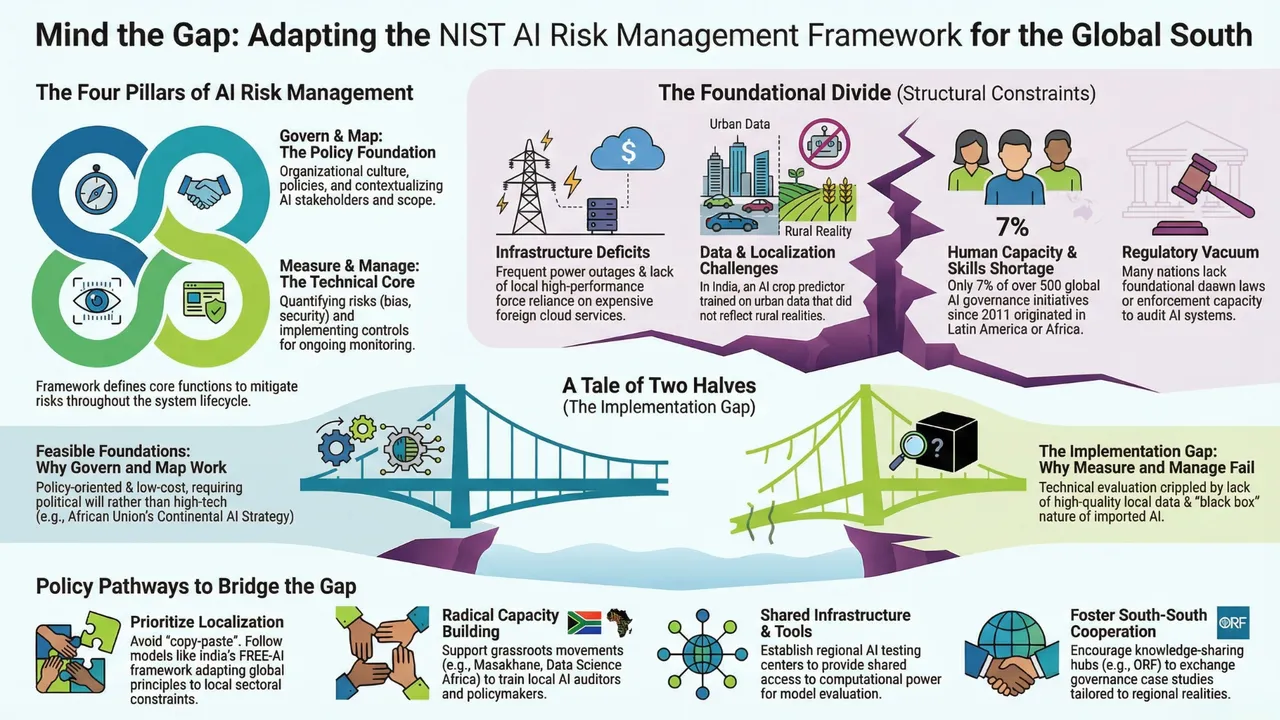
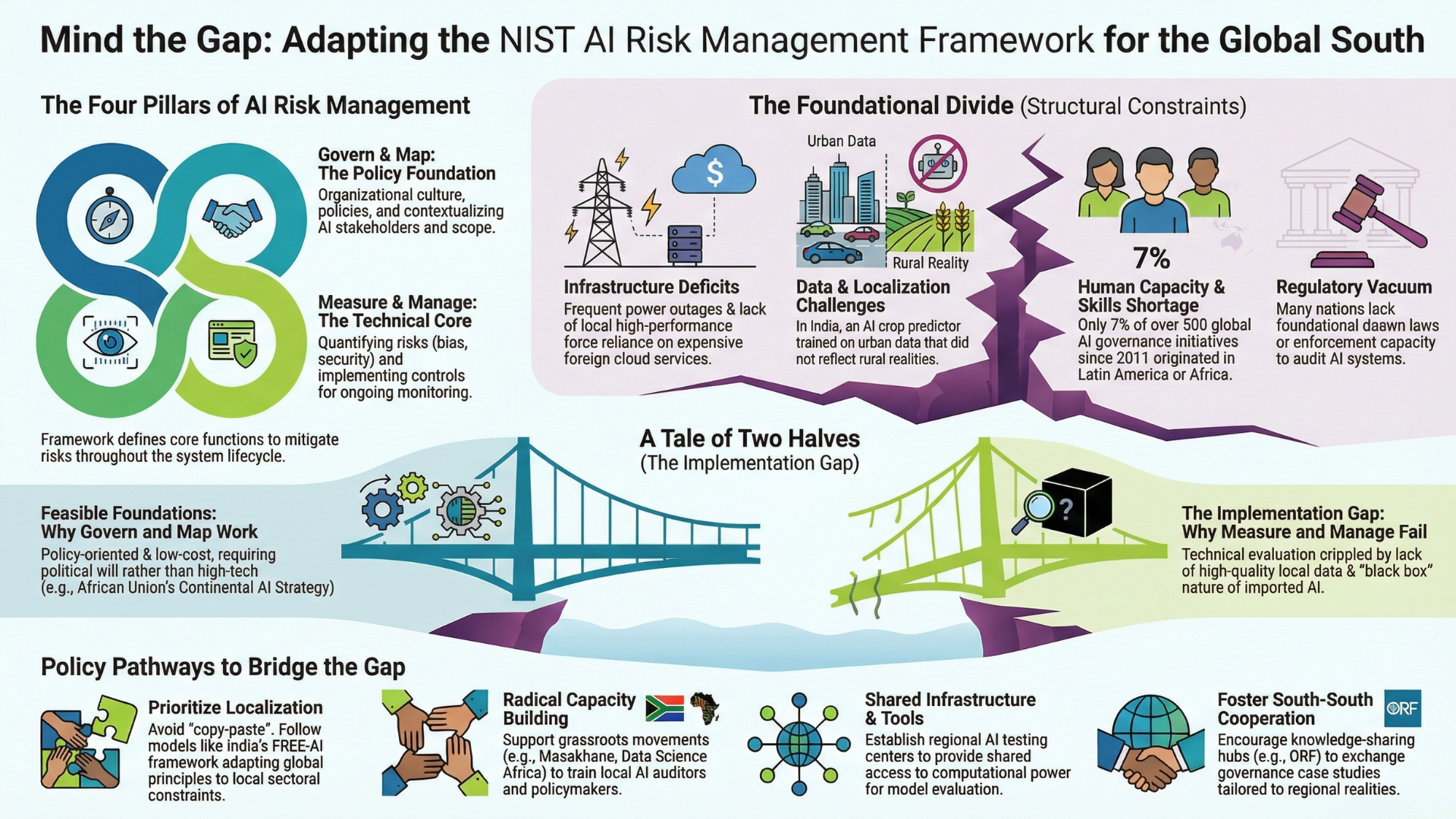
The NIST AI Risk Management Framework is one of the most influential AI governance frameworks in the world. It is designed to help organizations think through risks across the AI lifecycle.
The framework is organized around four core functions:
- Govern: set policies, roles, and accountability structures
- Map: understand the system, its context, and who may be affected
- Measure: assess harms, failures, and technical risks
- Manage: respond to identified risks and monitor them over time
In principle, this is a useful structure. The problem is that it assumes a level of capacity that many institutions in the Global South do not yet have.
2. Why the Framework Is Harder to Apply in the Global South
AI governance does not happen in a vacuum. It depends on electricity, internet access, compute, data quality, institutional capacity, and skilled people.
In many Global South settings, these conditions are uneven or fragile.
Common constraints include:
- limited compute and heavy dependence on foreign cloud providers
- incomplete, biased, or poorly digitized local datasets
- shortages of auditors, regulators, and technical reviewers
- weak legal enforcement and limited institutional coordination
This means that a framework that looks practical on paper may be much harder to use in practice.
3. Which Parts Are More Feasible and Which Parts Are Harder
One useful way to understand the NIST AI RMF in Global South contexts is to divide it into two groups.
More feasible starting points: Govern and Map
The Govern and Map functions are often more realistic because they are more organizational than deeply technical.
Institutions can still make progress by:
- setting oversight rules
- defining responsibilities
- documenting intended uses
- identifying affected communities
- mapping likely harms early
These steps matter because they help organizations ask the right questions before deployment.
Harder functions: Measure and Manage
The Measure and Manage functions are much more demanding.
To measure risk well, institutions often need:
- reliable test data
- subgroup analysis
- technical expertise
- stress testing capacity
- access to the model and its documentation
Without those conditions, risk measurement becomes weak or symbolic. And if risks are not measured properly, they cannot be managed properly either.
That is the central practical problem: the framework’s later stages depend on resources that many institutions do not yet have.
4. What This Looks Like in Practice
In a resource-rich setting, an organization may be able to test a model across different populations, document its failure modes, and update controls over time.
In a low-capacity setting, the same organization may face basic constraints:
- no local benchmark data
- no audit team
- no compute budget for testing
- no legal leverage over foreign vendors
- no clear path for ongoing monitoring
That does not make AI governance unnecessary. It means governance has to be adapted to what is operationally possible.
Otherwise, the result is performative compliance: policy language without meaningful oversight.
5. What a Better Adaptation Strategy Looks Like
The most useful response is not to reject the NIST AI RMF. It is to use it selectively and adapt it.
A practical adaptation strategy could include:
- Localize priorities: decide which risks matter most in local sectors such as agriculture, welfare, finance, health, and education.
- Invest in people: train auditors, regulators, and technical reviewers.
- Build shared infrastructure: regional testing centers and shared benchmarks can lower costs.
- Use phased implementation: start with governance and mapping, then expand measurement requirements as capacity grows.
- Strengthen South-South cooperation: countries can share methods, case studies, and tools instead of each building everything alone.
The aim should be usable governance, not imported complexity for its own sake.
6. Bigger Picture
The NIST AI RMF offers a useful vocabulary for thinking about AI risk. But vocabulary is not the same as implementation.
For the Global South, the core policy lesson is:
- keep the useful structure
- adapt the technical expectations
- match governance requirements to real capacity
- build toward stronger oversight over time
A framework only helps if institutions can actually use it. Otherwise it risks becoming a symbol of responsibility rather than a tool for it.
Related in this cluster
- Beyond America’s AI Action Plan: A Global South Response on Fairness
- When Good Intentions Go Global: Why the EU AI Act Doesn’t Fit the Global South
- Browse all AI Policy Tracker posts
📥 AI Policy Tracker — NIST AI RMF and the Global South Explainer Deck (PDF)
👉 Download the NIST AI RMF and Global South Explainer Deck (PDF)
💬 Join the Conversation
Have thoughts, experiences, or questions about AI governance and policy? Share your comments, discuss with global experts, and connect with the community:
👉 Reach out via the Contact page
📧 Write to us: [email protected]
🌍 Follow GlobalSouth.AI
Stay connected and join the conversation on AI governance, fairness, safety, and sustainability.
- LinkedIn: https://linkedin.com/company/globalsouthai
- Substack Newsletter: https://newsletter.globalsouth.ai/
Subscribe to stay updated on new case studies, frameworks, and Global South perspectives on responsible AI.
Related Posts

Beyond America's AI Action Plan: A Global South Response on Fairness
America's AI Action Plan's redefinition of fairness, by removing Diversity, Equity, and Inclusivity (DEI), risks hard-coding inequities for the Global South, necessitating a proactive response to define its own culturally and contextually relevant AI fairness standards.

When Good Intentions Go Global: Why the EU AI Act Doesn’t Fit the Global South
Why the EU AI Act—designed for data-rich, institutionally mature European economies—breaks down when applied to the Global South.

The Ghost in the Machine: Uganda's Ndaga Muntu and the High Cost of Digital Identity
How Uganda's Ndaga Muntu national ID system exposes the human cost of digital identity when legal status, public services, finance, education, and land rights depend on fragile registry infrastructure.