Beyond America's AI Action Plan: A Global South Response on Fairness
America's AI Action Plan's redefinition of fairness, by removing Diversity, Equity, and Inclusivity (DEI), risks hard-coding inequities for the Global South, necessitating a proactive response to define its own culturally and contextually relevant AI fairness standards.

AI-Policies
Part 1 of 3
Table of Contents
- 🎥 Explained: Global South fairness response on US AI Action Plan
- AI Policy Tracker - Explainer
- 1. What Changed in the U.S. Plan
- 2. Why “Neutral” Systems Can Still Be Harmful
- 3. Why the Global South Faces Greater Risk
- 4. What Some Global South Frameworks Are Doing Instead
- 5. What the Global South Should Do Next
- 6. Bigger Picture
- <img src="/assets/images/AIPolicyTracker_US_AI_Action_Plan_GlobalSouth_response_infographic_v1.png" alt="Global South response to fairness on US AI Action plan" style="width:100%; border-radius:10px; margin: 1rem 0;" />
- Related in this cluster
- 📥 AI Policy Tracker — America’s AI Action Plan and the Global South Explainer Deck (PDF)
- 💬 Join the Conversation
- 🌍 Follow GlobalSouth.AI
- Subscribe to stay updated on new case studies, frameworks, and Global South perspectives on responsible AI.
🎥 Explained: Global South fairness response on US AI Action Plan
AI Policy Tracker - Explainer
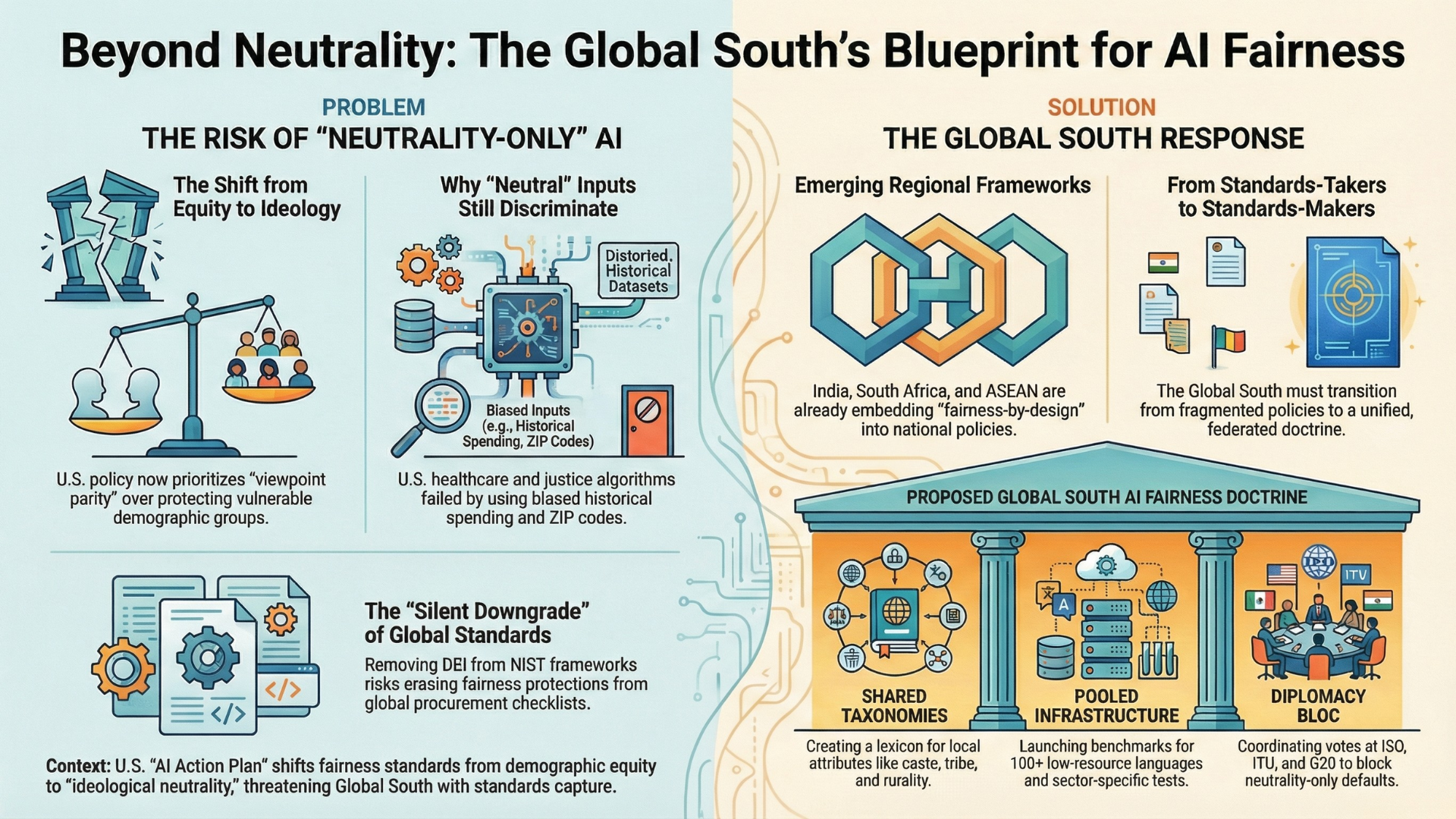
- 🇺🇸 Policy shift: the U.S. action plan reframes fairness away from demographic equity and toward ideological neutrality
- ⚠️ Main concern: systems can look politically "neutral" while still producing unequal outcomes across social groups
- 🌍 Why this matters globally: U.S. standards often influence procurement rules, industry practice, and international AI governance debates
- 🧭 Global South implication: countries may need their own fairness baselines rather than importing a narrower U.S. definition
⚠️ Key Takeaway
If fairness is redefined too narrowly, AI systems can pass compliance checks while still harming vulnerable groups. That risk is especially serious in Global South contexts shaped by caste, language, informality, and structural inequality.
1. What Changed in the U.S. Plan
America’s AI Action Plan signals a major shift in how fairness is discussed in U.S. AI policy. Instead of emphasizing whether AI systems produce unequal outcomes across demographic groups, the new approach places more emphasis on whether systems are seen as ideologically neutral.
That matters because fairness in high-stakes AI systems is usually not just about political viewpoint. It is about whether real people are denied jobs, loans, healthcare, education, or public services in unequal ways.
Three changes are especially important:
- Reduced emphasis on DEI-oriented fairness language: the plan pushes against diversity, equity, and inclusion framing in federal AI governance.
- Procurement focus on ideological neutrality: public-sector AI systems may be evaluated more through the lens of viewpoint balance than measurable social impact.
- A narrower fairness baseline: the policy discussion shifts from group-level outcomes toward claims of objectivity and neutrality.
The problem is that an AI system can sound neutral and still be unfair in practice.
2. Why “Neutral” Systems Can Still Be Harmful
AI systems trained on historical data do not become fair simply because they avoid explicit political language. They often learn from a world that is already unequal.
That means systems can reproduce discrimination even when they do not mention race, gender, caste, or class directly.
Two familiar examples help illustrate the point:
| Context | What went wrong |
|---|---|
| Healthcare (Optum) | A system used healthcare spending as a proxy for need, which disadvantaged Black patients because lower spending reflected unequal access, not lower illness |
| Criminal Justice (COMPAS) | Inputs that looked race-neutral still acted as proxies for race and produced unequal error patterns |
This is the core problem with a narrow neutrality standard: it may focus on whether a system appears politically balanced, while missing whether it produces discriminatory outcomes in the real world.
In legal and policy terms, that creates a serious gap. A model can be described as neutral and still violate anti-discrimination rules if its results disproportionately harm protected groups.
3. Why the Global South Faces Greater Risk
The stakes are higher in the Global South because the social realities are more layered and less likely to fit narrow imported standards.
In many countries, fairness concerns are shaped by:
- caste, tribe, religion, ethnicity, and language
- informal labor markets and weak documentation
- deep geographic inequality between urban and rural populations
- low-resource languages that perform poorly in mainstream AI systems
A procurement rule that asks only whether a system is ideologically neutral may completely miss whether:
- loan approvals are systematically worse for Dalit borrowers
- speech systems fail for low-resource language speakers
- admissions tools disadvantage rural or first-generation applicants
- welfare systems exclude those with informal work histories
In other words, a weak fairness baseline can downgrade safety without openly saying so.
4. What Some Global South Frameworks Are Doing Instead
A more grounded approach is already emerging across different regions. These frameworks do not assume that fairness is only about ideological balance. They treat fairness as something that must be tested against real social structures.
Examples include:
- India: sectoral approaches such as the RBI’s FREE-AI framework stress fairness-by-design and local legal realities.
- South Africa: policy development has emphasized the risk of reproducing historical exclusion.
- ASEAN: regional approaches focus on cooperation, local capability, and digital inclusion.
- Latin America: several proposals place stronger emphasis on human rights and impact assessment.
These approaches are not identical, but they share a common insight: fairness must be defined in ways that make sense for local institutions, local law, and local harms.
5. What the Global South Should Do Next
If U.S. standards move in a narrower direction, Global South countries should avoid treating that definition as the default.
A practical response could include five steps:
- Develop shared fairness vocabularies that reflect local social realities such as caste, tribe, dialect, rurality, and informality.
- Build evaluation infrastructure for low-resource languages and underserved populations.
- Coordinate in international standards forums so that one country’s narrow definition does not become the global baseline.
- Invest in local capacity for testing, auditing, and procurement review.
- Require stronger vendor disclosure in public-sector AI deployments, including subgroup outcomes and design assumptions.
The goal is not to reject international engagement. It is to make sure imported AI governance concepts do not erase locally important harms.
6. Bigger Picture
The larger issue is not only what the U.S. chooses to do domestically. It is whether that choice reshapes global expectations about what counts as fair AI.
For the Global South, fairness cannot be reduced to ideology alone. It must remain tied to whether systems produce unequal outcomes in labor markets, finance, healthcare, education, and public administration.
The policy lesson is clear:
- Do not confuse neutrality with fairness.
- Do not assume foreign baselines fit local realities.
- Do not let compliance language replace harm detection.
If the Global South wants AI governance that actually protects people, it will need to define and defend its own standards.
Related in this cluster
- When Good Intentions Go Global: Why the EU AI Act Doesn’t Fit the Global South
- Mind the Gap: Why the NIST AI Risk Framework Breaks Down in the Global South
- Browse all AI Policy Tracker posts
📥 AI Policy Tracker — America’s AI Action Plan and the Global South Explainer Deck (PDF)
👉 Download the America’s AI Action Plan and Global South Explainer Deck (PDF)
💬 Join the Conversation
Have thoughts, experiences, or questions about AI governance and policy? Share your comments, discuss with global experts, and connect with the community:
👉 Reach out via the Contact page
📧 Write to us: [email protected]
🌍 Follow GlobalSouth.AI
Stay connected and join the conversation on AI governance, fairness, safety, and sustainability.
- LinkedIn: https://linkedin.com/company/globalsouthai
- Substack Newsletter: https://newsletter.globalsouth.ai/
Subscribe to stay updated on new case studies, frameworks, and Global South perspectives on responsible AI.
Related Posts
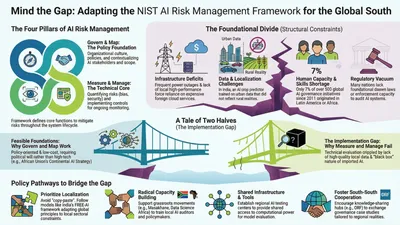
Mind the Gap: Why the NIST AI Risk Framework Breaks Down in the Global South
The NIST AI Risk Management Framework (AI RMF) is increasingly treated as a global blueprint for “trustworthy AI.” But what happens when a framework designed for resource-rich Western institutions is applied to the Global South?

When Good Intentions Go Global: Why the EU AI Act Doesn’t Fit the Global South
Why the EU AI Act—designed for data-rich, institutionally mature European economies—breaks down when applied to the Global South.

How AI Bias Locked Out Millions of Job Seekers (A Case Study on Mobley v. Workday)
The Mobley v. Workday lawsuit represents a landmark shift in legal accountability, establishing that AI software vendors can be held liable as agents for discriminatory hiring practices that exclude qualified candidates. The case highlights how black box algorithms can systematically penalize individuals based on race, age, and disability through biased training data and the use of neutral proxies. This legal evolution signals a broader mandate for Accountability by Design, requiring employers and developers to ensure transparency and human oversight in automated recruiting systems