
When Good Intentions Go Global: Why the EU AI Act Doesn’t Fit the Global South
Why the EU AI Act—designed for data-rich, institutionally mature European economies—breaks down when applied to the Global South.

AI-Policies
Part 2 of 3
Table of Contents
- 🎥 Explained: Beyond the Brussels Effect – Why the EU AI Act Fails the Global South
- 1. The Foundational Mismatch: Deconstructing European Assumptions
- 2. Innovation on the Line: High-Risk vs. High-Opportunity
- 3. The Geopolitics of AI: Sovereignty and the “Regulatory Imperialism””
- 4. A Strategic Path Forward: Toward Pluralistic AI Governance
- 5. Conclusion: Context as the Foundation
- 📥 AI Policy Tracker — EU AI Act and the Global South Explainer Deck (PDF)
- 💬 Join the Conversation
- 🌍 Follow GlobalSouth.AI
- Subscribe to stay updated on new case studies, frameworks, and Global South perspectives on responsible AI.
🎥 Explained: Beyond the Brussels Effect – Why the EU AI Act Fails the Global South
1. The Foundational Mismatch: Deconstructing European Assumptions
The European Union’s AI Act, passed in 2024, is frequently lauded as the global “gold standard” for artificial intelligence regulation. However, this landmark legislation is not a universal blueprint. It is a localized product of Europe’s specific socio-economic maturity, shaped by data-rich environments and robust institutional frameworks.
For developing nations, transposing these rules without meaningful adaptation creates a fundamental operating system mismatch. Attempting to run the Global South’s developmental priorities on European regulatory software risks stalling the very innovations needed to address urgent challenges.
The EU AI Act must be recognized for what it is: a regulatory monoculture that threatens global digital biodiversity.
Four Structural Disconnects
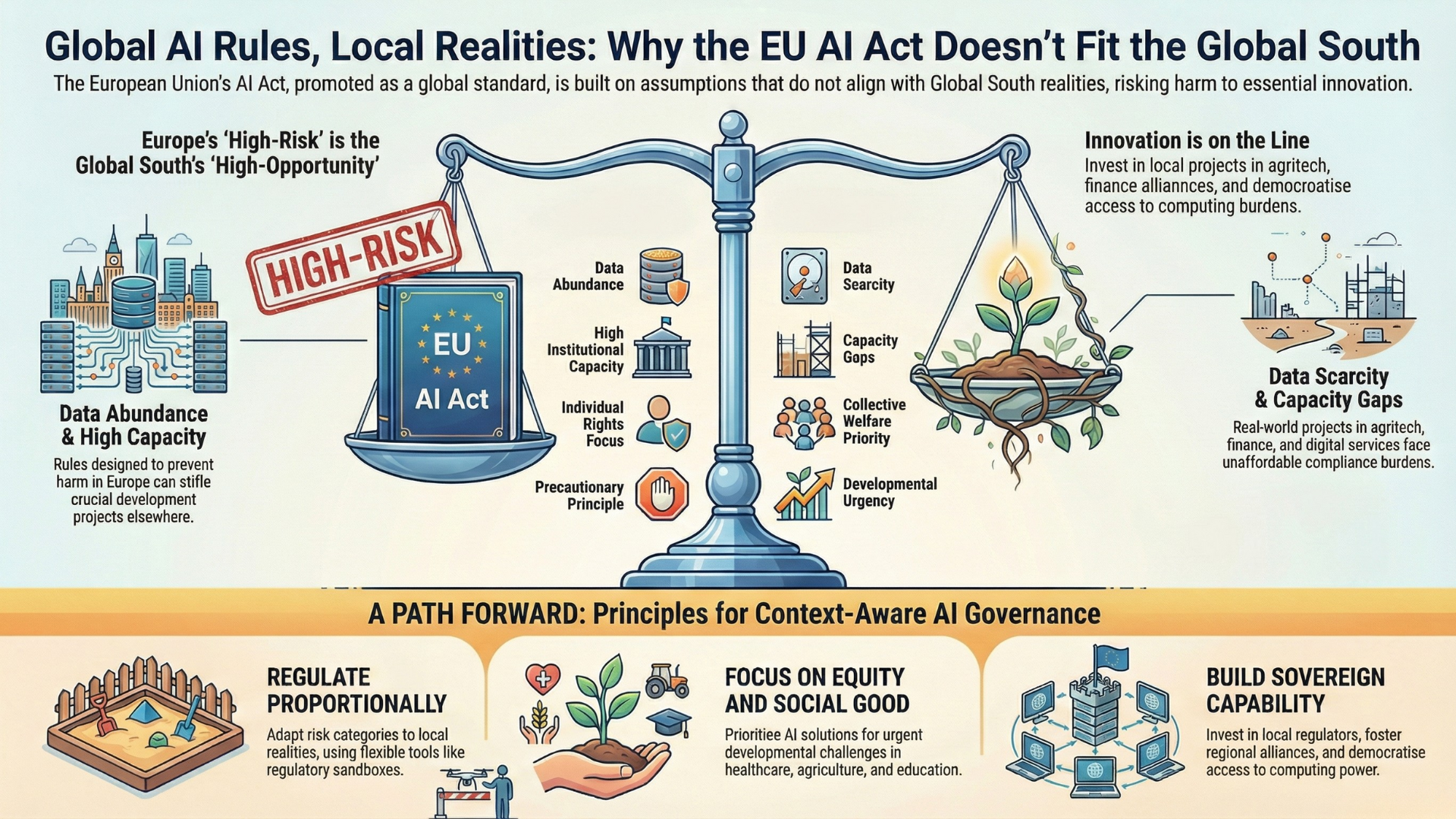
Every regulation rests on hidden assumptions about its operating environment. The EU AI Act presumes a world of abundant data, robust legal norms, and particular societal values. The gap between European assumptions and Global South realities rests on four pillars:
-
Data Abundance vs. Data Scarcity
Europe’s rules assume access to clean, well-labelled datasets and a capacity for exhaustive documentation. In regions such as Sub-Saharan Africa, where only one-third of the population is online, such data does not exist. Developers rely on noisy, crowdsourced, or scraped data. The Act’s rigid documentation mandates divert scarce resources from innovation to compliance. -
Institutional Maturity vs. Capacity Gaps
The EU model depends on trained auditors and well-funded regulators. Most Global South governments lack these resources, turning regulation into paper compliance while pricing out small local innovators unable to afford high-cost audits. -
Individual Rights vs. Collective Welfare
The Act is rooted in individual-rights jurisprudence. While these values are universally important, many Global South societies operate on communitarian ethics—Ubuntu, Dharmic, and Confucian traditions—where collective benefit is prioritized.Europe’s hard-learnt lessons on individual abuses are reflected in the strict rules of the EU Act, such as banning certain uses of biometrics or limiting personal data processing. But in a developing nation, a rigid insistence on individual consent forms might inadvertently block applications that communities want – say, an AI tool to allocate farming subsidies or pandemic aid, even if it uses personal data. A strictly rights-based yardstick may not capture the communal benefits that local stakeholders prioritise.
-
Precautionary Principle vs. Developmental Urgency
The EU’s “better safe than sorry” mindset assumes that societies can afford the luxury of delay. In emerging economies, delayed deployment in agriculture, education, finance, and healthcare can cost lives. When lives and livelihoods are at stake, waiting years for exhaustive risk assessments or conformity certifications is not an option. Emerging economies seek a more balanced approach that manages harms while allowing AI to scale quickly for development gains.
These mismatches impose a brutal trade-off between compliance and survival. EU safeguards function as a poverty tax, penalizing nations for being data-poor and institutionally lean.
These are not theoretical issues. They materialize as lost opportunities and stalled deployments across the Global South.
2. Innovation on the Line: High-Risk vs. High-Opportunity
In Europe, certain AI systems are labeled “high-risk” to prevent harm. In the Global South, those same systems often represent high-opportunity pathways toward inclusion.
When regulation overreaches, it does not manage risk—it suppresses progress.
Case Studies
India’s Bhashini (Language Inclusion vs. Red Tape)
- Context: The Indian government’s Bhashini platform is a flagship project designed to democratise AI so that start-ups, researchers, and even government agencies can easily build translation tools, voice assistants, and digital services—breaking down the country’s vast language barriers. This project has already enabled live translation of official speeches, e-governance apps, and voice-based rural services.
- EU Constraint: The EU Act would classify many of these models as general-purpose AI, necessitating bias audits, documentation, and conformity checks. For a public initiative designed to empower small developers, such a procedural weight could cripple openness and speed and derail India’s efforts to make AI inclusive for 1.4 billion people.
India’s regulators instead favour a use-based approach—lighter oversight for public-interest AI. The difference is philosophical: Europe seeks to control risk before innovation; India seeks to expand innovation while managing risk.
Kenya’s Precision Agriculture ( Small Innovators vs. Compliance Costs)
- Context: Kenya’s “Silicon Savannah” hosts dozens of agritech start-ups using satellite imagery and weather data to guide smallholder farmers on pest control, crop disease, and optimal planting times, boosting yields and food security. For instance, tools like Hello Tractor can detect crop diseases early and save billions of dollars in crop losses across sub-Saharan Africa.
- EU Constraint: EU-style rules would classify such livelihood-affecting systems as high-risk, triggering costly conformity assessments. A small Kenyan startup building drought-prediction models could be forced to document every aspect of their training data (much of it scraped from disparate sources) and prove the explainability of their model’s suggestions – all before field-testing them at scale. They might be forced out of the market by such compliance costs, stifling homegrown solutions and reinforcing a form of “digital colonialism” where only large foreign firms can compete.
Nigeria’s Digital ID (Inclusion vs. Algorithmic Restrictions)
- Context: Nigeria’s national biometric ID program uses AI-powered biometrics—fingerprints, facial images, and iris scans—to provide over 200 million citizens with access to banking, healthcare, and social welfare.
- EU Constraint: The EU AI Act bans or tightly restricts many biometrics applications. Imposing severe audit and accountability requirements could slow down the project’s rollout and jeopardise its goal of bringing millions to the formal economy. The trade-off is between an AI-assisted system that improves equity (bringing millions into the formal economy) versus maintaining the status quo of exclusion.
This case exemplifies how a strictly individual-rights lens may undervalue collective benefits in the Global South context.
Latin American Fintech ( Alternative Credit Scoring vs. the High-Risk Label )
- Context: Across Latin America, AI startups are tackling financial exclusion by using alternative data like mobile phone records and utility payments to generate credit scores for the unbanked. These models are unlocking capital for small entrepreneurs who would never qualify for a traditional bank loan. Platforms such as Tala and Branch enable microloans and entrepreneurial growth. The social impact is significant: more entrepreneurs can obtain capital, family businesses grow, and informal economy participants gain a financial footprint.
- EU Constraint: Under the EU Act, all AI-based credit scoring is “high-risk”, imposing compliance burdens that small fintech startups offering microloans cannot afford. The result would be market exit or consolidation — innovation sacrificed at the altar of compliance.
Across these examples, what Europe calls “high-risk” often represents “high-opportunity” in the Global South. The tension between precaution and potential defines the new fault line in AI governance.
This pressure is driven by geopolitical asymmetries that allow Western standards to propagate globally with limited Global South participation.
3. The Geopolitics of AI: Sovereignty and the “Regulatory Imperialism””
The EU’s regulatory reach extends far beyond its borders through the Brussels Effect: companies and governments worldwide adapt to EU rules to retain market access. The sheer size of the EU’s 450-million-consumer market affords it the power to compel foreign companies and governments to adopt its rules as a de facto global norm.
If Global South simply imports the EU Act via trade agreements or diplomatic pressure, they risk becoming “standard takers” instead of standard makers. Scholars warn of an emerging “algorithmic empire” — values encoded in Western laws exported through technical standards and trade leverage.
The irony is that the Global South was absent from the original AI governance drafting tables. Despite the intention to elevate global standards, this dynamic sparks worries about regulatory imperialism, policy sovereignty, and the rise of “digital colonialism”.
Emerging economies are responding selectively: borrowing Europe’s rights emphasis, China’s innovation pragmatism, and their own developmental priorities—from South Africa’s community-benefit clause to Brazil’s AI for Sustainable Development bill. This pluralism offers a genuine opportunity for the Global South to chart its own course.
Moving beyond critique requires building pluralistic governance tools, not rejecting regulation outright.
4. A Strategic Path Forward: Toward Pluralistic AI Governance
AI governance does not require a single gold standard, but a gold spectrum. Context is the foundation of safety.
Strategic Mandates
-
Regulate Proportionally
One size will not fit all when it comes to AI rules. We should adopt the spirit of the EU AI Act’s risk-based oversight but tailor categories to local realities.A fintech lending model in Nigeria or Kenya should not face the same rules as a medical diagnostic system. ’
Regulators can phase in standards by starting with voluntary codes and sandboxes, gathering evidence, and then making laws. Sunset clauses and iterative reviews prevent rigidity. Such experimental governance mirrors how successful digital financial regulations evolved — learning by doing rather than legislating by fear.
-
Prioritize Equity and Collective Good
AI governance in developing countries should explicitly aim to maximise social benefits and equity, not just prevent harm.The guiding question for policymakers must shift from solely “How do we stop adverse outcomes?” to include “How do we encourage AI solutions for our most pressing problems?”
The Basic AI Act in South Korea is a good example of how to combine strict rules with support for AI development.
African and Latin American strategies similarly emphasise AI for social goods (such as education, healthcare, and sustainable agriculture) along with ethical safeguards. An equity lens also means including people who are most affected by AI in the process of making policies.The nations of the Global South should undertake inclusive, bottom-up consultations—engaging farmers, teachers, small business owners, and others—to identify what safeguards they want and what benefits they expect from AI. This helps ensure the governance model reflects on-the-ground values and doesn’t simply copy a European rights template that might ignore local priorities.
-
Build Regulatory Capacity and Coalitions
To transition from rule-takers to rule-makers, nations in the Global South must invest in their own institutional capacities by training regulators and creating specialised agencies. Given resource constraints, regional cooperation is key. Countries can pool expertise by establishing multi-country expert panels, sharing best practices, and even creating joint regulatory sandboxes or testbeds.For instance, Latin America could form an AI governance network (like the Pan-American AI Observatory) to harmonise approaches and present a united front in global forums. South-South collaboration (e.g., the African Union’s AI strategy or collaborations between India and Africa on digital public goods) can generate homegrown models of governance.
The goal is to avoid isolation and leverage strength in numbers to assert the Global South’s voice in setting AI norms.
-
Democratise access to computing and infrastructure
Rules on paper mean little if countries lack the means to develop and use AI safely.Many Southern labs pay 50 to 100 times more per AI training than European peers.
Compliance testing, fairness audits, and safety validation all require compute ower. Without investment in affordable data centres and shared infrastructure, only Big Tech can comply— deepening dependency. Kenya’s geothermal-powered data centre partnership with Microsoft illustrates how local green computing capacity can close this gap. “Compute equity” must become a core pillar of global AI justice.
-
Champion a Pluralistic Global Vision
The world needs not a single “gold standard” but a gold spectrum—various models aligned to local values. The Global South should use platforms like the UN Global Digital Compact and GPAI to push for contextual regulation — balancing innovation, safety, and justice. By sharing successful case studies—Rwandan healthcare sandboxes and Brazil’s balanced AI bill—these countries can shift global discourse from replication to representation.
5. Conclusion: Context as the Foundation
The EU AI Act is a landmark achievement in technology governance. It defends what Europe treasures most: individual rights and institutional trust. However, its direct transposition to the Global South is both inappropriate and counterproductive. The structural assumptions of data abundance, high institutional capacity, and a purely individual-rights focus diverge sharply from the realities in developing nations, threatening to smother the very innovations needed to address urgent social and economic needs.
Rather than rejecting Europe’s model, the Global South can adapt it— combining its risk logic with developmental urgency and collective ethics. The aim should be sovereign interoperability: rules that communicate globally but are grounded locally.
The future of global AI governance must be a conversation among equals, not a monologue. The Global South’s lived experience of scarcity, resilience, and social cooperation provides it unique insight into how AI can serve humanity rather than markets. In a world increasingly shaped by algorithms, context is not a footnote; it is the foundation.
📥 AI Policy Tracker — EU AI Act and the Global South Explainer Deck (PDF)
👉 Download the EU AI Act and the Global South Explainer Deck (PDF)
💬 Join the Conversation
Have thoughts, experiences, or questions about AI fairness? Share your comments, discuss with global experts, and connect with the community:
👉 Reach out via the Contact page
📧 Write to us: [email protected]
🌍 Follow GlobalSouth.AI
Stay connected and join the conversation on AI governance, fairness, safety, and sustainability.
- LinkedIn: https://linkedin.com/company/globalsouthai
- Substack Newsletter: https://newsletter.globalsouth.ai/
Subscribe to stay updated on new case studies, frameworks, and Global South perspectives on responsible AI.
Related Posts

Beyond America's AI Action Plan: A Global South Response on Fairness
America's AI Action Plan's redefinition of fairness, by removing Diversity, Equity, and Inclusivity (DEI), risks hard-coding inequities for the Global South, necessitating a proactive response to define its own culturally and contextually relevant AI fairness standards.
Mind the Gap: Why the NIST AI Risk Framework Breaks Down in the Global South
The NIST AI Risk Management Framework (AI RMF) is increasingly treated as a global blueprint for “trustworthy AI.” But what happens when a framework designed for resource-rich Western institutions is applied to the Global South?

When an Algorithm Broke Thousands of Families: The Netherlands Child Welfare Scandal
How a design-phase failure in the Dutch childcare fraud algorithm created one of the worst AI governance disasters in Europe — and what the Global South must learn from it.