
Mind the Gap: Why the NIST AI Risk Framework Breaks Down in the Global South
The NIST AI Risk Management Framework (AI RMF) is increasingly treated as a global blueprint for “trustworthy AI.” But what happens when a framework designed for resource-rich Western institutions is applied to the Global South?
AI-Policies
Part 3 of 3
Table of Contents
- 🎥 Explained: Why the NIST AI Risk Framework Breaks Down in the Global South
- 1. Introduction: The Mirage of Universal AI Standards
- 2. The Foundational Divide: Structural Constraints to Adoption in the Global South
- 3. A Tale of Two Halves: Assessing the Four Pillars
- 4. Strategic Pathways: From Passive Adoption to Intelligent Adaptation
- 5. Conclusion: Reclaiming the Narrative of AI Governance
- 📥 AI Policy Tracker — NIST AI RMF and the Global South Explainer Deck (PDF)
- 💬 Join the Conversation
- 🌍 Follow GlobalSouth.AI
- Subscribe to stay updated on new case studies, frameworks, and Global South perspectives on responsible AI.
🎥 Explained: Why the NIST AI Risk Framework Breaks Down in the Global South
1. Introduction: The Mirage of Universal AI Standards
As artificial intelligence reshapes the global economic order, the U.S. National Institute of Standards and Technology’s AI Risk Management Framework (NIST AI RMF) has emerged as a dominant blueprint for “trustworthy AI.”
While its proponents argue that promoting NIST-aligned frameworks can establish a global baseline for safety, this one-size-fits-all approach masks a profound strategic tension. A framework born within a resource-rich, Western institutional landscape is fundamentally ill-equipped for the socio-technical realities of the Global South.
By treating governance as a universal plug-and-play solution, the international community risks entrenching a new era of digital dependency and technological neo-colonialism.
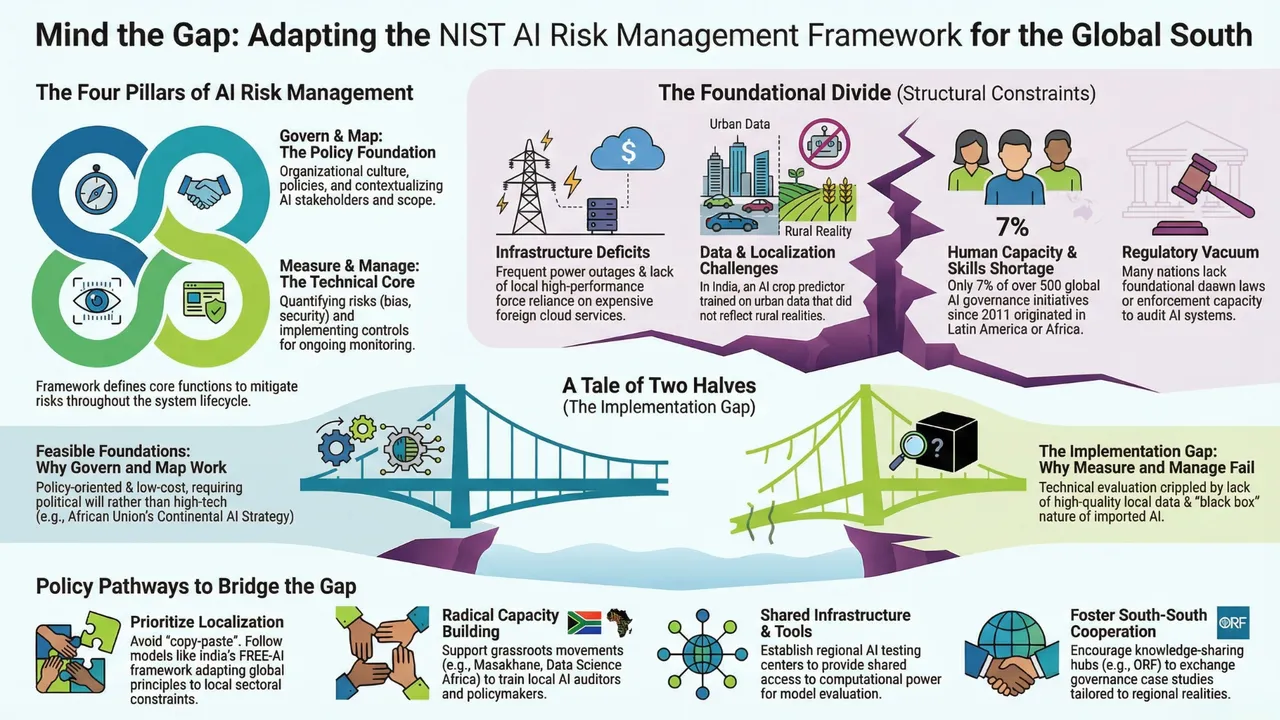
The Four Core Functions of the NIST AI RMF
The NIST AI RMF is structured around four functions intended to manage risks across the AI lifecycle:
-
Govern
Establishing organizational culture, accountability structures, and policies for AI oversight. -
Map
Defining system scope, stakeholders, and potential impacts early in the lifecycle. -
Measure
Applying quantitative and qualitative tools to assess risks such as bias, security vulnerabilities, and error rates. -
Manage
Implementing controls, monitoring mechanisms, and response plans to mitigate identified risks.
The Central Failure
The central failure of this voluntary U.S. blueprint is its assumption of a level playing field.
When Western governance guidelines become de facto global standards, they systematically exclude the institutional and infrastructural constraints of developing nations. For the Global South, the dominant risk is not only the misuse of AI, but the missed use of AI for urgent development goals due to governance requirements that are financially and technically out of reach.
The result is a veneer of safety that leaves nations structurally vulnerable to the very technologies they seek to regulate.
2. The Foundational Divide: Structural Constraints to Adoption in the Global South
AI governance cannot be separated from a nation’s digital maturity. In the Global South, the missed use of AI in food security, healthcare, and economic inclusion is as damaging as algorithmic bias itself.
When high-level principles are divorced from infrastructural reality, governance frameworks cease to protect and instead become barriers to participation.
Infrastructure and Data Deficits
Governance frameworks assume reliable electricity, connectivity, and access to compute. In many regions, these conditions do not exist.
- Frequent power outages and limited internet access force reliance on foreign cloud providers.
- The absence of local high-performance computing creates a dependency trap, trading sovereignty for basic operability.
- The RMF’s reliance on high-quality data ignores pervasive data deserts. Key datasets (e.g., health records, financial data, and demographic information) may be incomplete, poorly digitised, or heavily biased toward urban and elite populations. AI models that learn from this kind of data make mistakes.
Examples include:
- Crop yield prediction models in India trained on urban weather data that failed rural farmers.
- Frequent power outages and limited internet penetration have hampered even basic ICT operations in African countries
- Colombian e-commerce algorithms that discriminated against low-income users due to urban-centric transaction histories.
These are not edge cases. They are failures of data readiness, making Western-style risk detection structurally impossible.
Human Capital and Regulatory Gaps
Technical governance capacity is constrained by:
- Severe skills shortages
- Persistent brain drain to the U.S. and Europe
The imbalance is stark. Of over 500 global AI governance initiatives launched since 2011, only 7% originated in Latin America or Africa.
This produces a regulatory vacuum:
- No local auditors to examine models
- No institutional enforcement capacity
- High-risk deployments in policing or welfare remain unchecked
Barriers to RMF Implementation
| Constraint Category | Strategic Impact on Risk Management |
|---|---|
| Infrastructure Deficits | Dependence on foreign providers makes local testing and compute-intensive measurement infeasible. |
| Data & Localization | Fragmented data creates black-box failures and prevents detection of local socio-economic bias. |
| Human Capital Gap | Brain drain limits the ability to conduct audits or design context-aware mitigations. |
| Regulatory Vacuum | Weak legal mandates remove incentives to adopt or enforce risk protocols. |
Together, these constraints create a Governance Mirage: formal policy adoption without real technical oversight.
3. A Tale of Two Halves: Assessing the Four Pillars
Applying the NIST AI RMF in resource-constrained environments exposes a functional fracture. The four pillars do not carry equal weight.
They divide into:
- Policy-oriented functions that are feasible
- Technical functions that require autonomy many nations lack
The Feasible Foundations: Govern & Map
The Govern and Map functions are relatively more accessible starting points for institutions in the Global South. This is because they are primarily process and policy oriented, are relatively low-cost, and only demand political will, strategic planning, and stakeholder engagement instead of advanced technological infrastructure or deep technical expertise.
The Govern function, which focuses on establishing oversight and accountability, is seeing promising initial traction. National AI strategies have emerged in countries from Nigeria to Kenya, and the African Union has released a “Continental Artificial Intelligence Strategy” to guide member states. In India, the Reserve Bank of India (RBI) has developed its own “FREE-AI” framework (Framework for Responsible and Ethical Enablement of AI) for the financial sector. By setting such governance blueprints, Global South countries are at least defining the “rules of the road” for AI in their context.
Similarly, the Map function involves understanding and documenting how an AI system is used, its objectives, the stakeholders affected, and the context in which it operates. In short, it’s about finding possible risks early by mapping out the AI lifecycle and use case. For example, a public agency deploying an AI system for, say, automating welfare eligibility could at least map out the system’s purpose (e.g. speeding up subsidy distribution), the data it uses (citizens’ income records), and whom it impacts (various demographic groups). Such mapping does not inherently demand heavy computation; it demands due diligence and inclusive thinking (engaging relevant stakeholders, considering social context). For a government agency in a developing nation, mapping is as much about identifying opportunities for AI to advance agriculture or healthcare as it is about cataloguing potential harms.
However, caveats remain: governance on paper does not guarantee enforcement in practice. Furthermore, the map function can be rendered incomplete if local communities are not consulted or if AI systems are imported as opaque “black boxes” from foreign vendors, leaving local users with no visibility into their inner workings.
Thus, governance frameworks need calibration to local realities, and mapping must be done with an inclusive, local lens. With those adjustments, the first two pillars can establish a foundation upon which to build.
The real strain, however, comes with the next two pillars – Measure and Manage – where the Global South’s limitations become far more acute.
The Implementation Gap: Measure & Manage
The fracture deepens at Measure and Manage. The Measure and Manage functions represent the technical core of the NIST framework, and it is here that the resource and capacity gaps in the Global South become most acute, creating a significant implementation gap.
The measure function involves the technical evaluation of an AI model’s accuracy, bias, security, and robustness. This is often prohibitively challenging. The lack of high-quality local data for testing is a direct consequence of the data and localisation challenges discussed earlier; incomplete or non-digitized datasets make robust testing an impossibility from the outset. Insufficient computational resources make the intensive stress-testing required for rigorous measurement too costly. Finally, the opacity of proprietary AI systems, often imported from foreign vendors, means local users often have “no visibility into the code or data,” making independent measurement impossible.
The failure to measure risk inevitably cripples the manage function, which is dedicated to mitigating those risks. You can only manage what you have measured. Even when risks are identified, significant barriers remain. This institutional vacuum is a symptom of the broader governance and regulatory gaps and the human capacity and skills gap, leaving no one to enforce or even design effective mitigation strategies.
This breaks the Measure → Manage dependency. Risks that cannot be measured cannot be mitigated.
As a result, “management” becomes performative rather than operational, leaving nations in a state of persistent technical vulnerability.
The NIST AI RMF thus delivers only half a solution, demanding a shift from passive compliance to active adaptation.
4. Strategic Pathways: From Passive Adoption to Intelligent Adaptation
The goal for policymakers in the Global South should not be to discard global frameworks like the NIST AI RMF; a concerted effort is needed to bridge the gap between aspiration and capability. This involves adapting frameworks to local contexts, building capacities, and fostering collaborations that compensate for resource limitations.
Key Strategic Pathways
-
Prioritize Localization
A “copy-paste” approach to AI governance is destined to fail. Local context should dictate what “trustworthy AI” means: for example, in an agriculture-heavy economy, reliability and accessibility of AI for farmers might be a top priority, whereas for a country concerned about ethnic biases, fairness across languages or groups might be a primary priority. The Reserve Bank of India’s FREE-AI framework serves as an excellent model, translating global principles into actionable, sector-specific guidelines that explicitly address local constraints like capacity. -
Invest Radically in Capacity
The most critical long-term investment is in people. Governments and international partners must support programs to train a new generation of local AI auditors, regulators, policymakers, and ethicists. This includes supporting grassroots movements like Masakhane and Data Science Africa, which are building foundational AI expertise on the continent, and creating formal training programs for civil servants. -
Build Shared Infrastructure
We must lower technical barriers to make the measure and manage functions feasible. International cooperation can play a key role in establishing regional AI testing centres, which would provide shared access to the computational power and datasets needed to evaluate models. This would allow local regulators and developers to test critical AI systems without bearing the full cost of the infrastructure. -
Foster South–South Cooperation
Global South nations can accelerate their progress by sharing knowledge, data, and best practices with one another. Countries like India, with its early experience in sectoral AI regulation, can share valuable lessons with others. Think tanks and research institutions, such as the Observer Research Foundation (ORF), can act as crucial knowledge hubs, facilitating dialogue and developing a repository of governance case studies tailored to Global South realities.
These pathways move governance from symbolic compliance toward practical empowerment. A roadmap for moving from high-level principles to practical, on-the-ground implementation that respects local context.
5. Conclusion: Reclaiming the Narrative of AI Governance
The transition from blind adoption to intelligent adaptation is essential for digital sovereignty.
While the NIST AI RMF offers useful vocabulary, its technical core remains aspirational under deep structural divides. Imposing these standards without closing infrastructure and skills gaps produces a façade of governance that conceals real harm.
AI governance must be relevant, accessible, and enforceable to support equitable development. The Global South must innovate in governance itself—crafting frameworks as diverse and resilient as the societies they aim to protect.
The ultimate goal is not to reject global standards but to build the local capacity required to adapt them intelligently.
📥 AI Policy Tracker — NIST AI RMF and the Global South Explainer Deck (PDF)
👉 Download the NIST AI RMF and Global South Explainer Deck (PDF)
💬 Join the Conversation
Have thoughts, experiences, or questions about AI fairness? Share your comments, discuss with global experts, and connect with the community:
👉 Reach out via the Contact page
📧 Write to us: [email protected]
🌍 Follow GlobalSouth.AI
Stay connected and join the conversation on AI governance, fairness, safety, and sustainability.
- LinkedIn: https://linkedin.com/company/globalsouthai
- Substack Newsletter: https://newsletter.globalsouth.ai/
Subscribe to stay updated on new case studies, frameworks, and Global South perspectives on responsible AI.
Related Posts

Beyond America's AI Action Plan: A Global South Response on Fairness
America's AI Action Plan's redefinition of fairness, by removing Diversity, Equity, and Inclusivity (DEI), risks hard-coding inequities for the Global South, necessitating a proactive response to define its own culturally and contextually relevant AI fairness standards.

When Good Intentions Go Global: Why the EU AI Act Doesn’t Fit the Global South
Why the EU AI Act—designed for data-rich, institutionally mature European economies—breaks down when applied to the Global South.

The Golden Touch of Ruin: How Michigan’s MiDAS Algorithm Falsely Accused 40,000 People of Fraud
A deep dive into Michigan’s MiDAS unemployment fraud algorithm — and how design-phase failures, automation bias, and the removal of human oversight turned efficiency into injustice.